





Learning Modules Hide
Hide
- Chapter 1: Power of Combined Technical Indicators – Part 1
- Chapter 2: Power of Combined Technical Indicators – Part 2
- Chapter 3: Directional Movement System
- Chapter 4: Rate of Change Indicator (ROC)
- Chapter 5: Comparative Relative Strength Indicator
- Chapter 6: Types of Market Days – Part 1
- Chapter 7: Types of Market Days – Part 2
- Chapter 8: Pivot Points - Part 1
- Chapter 9: Pivot Points – Part 2
- Chapter 10: Value Area Trading – Part 1
- Chapter 11: Value Area Trading – Part 2
- Chapter 1: Introduction to Technical Analysis
- Chapter 2: Introduction to Charts and Chart Types
- Chapter 3: Trends, Support, and Resistances
- Chapter 4: Breakouts, Stops and Reversals
- Chapter 5: Fibonacci Retracements
- Chapter 6: Candlestick Patterns - One and Two Candle Patterns
- Chapter 7: Candlestick Patterns: Three Candle Patterns
- Chapter 8: Chart Patterns
- Chapter 9: Moving Averages and Crossovers
- Chapter 10: Price Volume Confirmation
- Chapter 11: Technical Indicators - Part 1: MACD and Stochastics
- Chapter 12: Technical Indicators - Part 2: Bollinger Bands and Relative Strength Index (RSI)
- Chapter 13: Do’s and Don’ts for Effective Trading Using Technical Analysis

Chapter 5: Comparative Relative Strength Indicator
Imagine you're interested in buying a new smartphone, but you're not sure which one to choose. You've narrowed it down to two options: the iPhone and the Samsung Galaxy. You've done some research on both phones, but you're still not sure which one is the better choice.
One way to come to a decision is to compare the performance of the iPhone and the Samsung Galaxy based on their features, price, and other factors that are important to you.
What you have just done is run a comparative relative strength (CRS) analysis to compare the performance of two options and see which one is outperforming the other.
In stock markets, the CRS can help you in narrowing down your investment options by providing you with a way to compare the performance of different assets. By using the CRS to compare the relative strength of two assets, you can identify which one is performing better and consider investing in that asset.
Comparative Relative Strength (CRS) is an indicator that compares the performance of one security to another with a ratio chart. This indicator is also known as the Price Relative indicator or Comparative Price Indicator or Relative Strength Comparative. It's a useful tool for traders and analysts who want to gain insight into market trends and identify potential trading opportunities.
The presumption behind the concept of comparative relative strength is that strength of a stock over the other will continue, similar to how a trend will continue, and that by recognizing the strongest investments, an edge can be obtained by investing in them until their strength abates.
Relative strength helps traders identify stocks that are performing better or worse compared to others in the market that can potentially capture higher returns and generate alpha, which represents the excess return of an investment compared to a benchmark. Relative strength analysis aids in optimizing portfolio allocation by emphasizing investments with the strongest relative performance. Monitoring relative strength can also serve as a risk management tool as stocks with weak relative strength may signal potential downside risk or deteriorating fundamentals, prompting traders to adjust their positions or implement risk mitigation strategies to protect against losses.
Please note that Comparative relative strength is not to be confused with the more common Relative Strength Index (RSI). RSI is an indicator that measures the strength of price action in a particular market. RSI indicates if the stock or security is overbought or oversold relative to its past price action over a specific period of time. You can learn more about RSI in the Technical Analysis Basic module.
Read More: What is comparative relative price indicator?
Calculation of Comparative Relative Strength
Comparative Relative Strength = Base security / Comparative security
- If CRS is in an uptrend àBase security outperforming comparative security
- If CRS is in a downtrend à Base security underperforming comparative security
For example, you can use the Comparative Relative strength to show the performance of TATA Motors relative to the Nifty50, or you can also compare the stock’s performance relative to its industry’s index, that is comparing it with Nifty Auto Index (CNXAUTO), or compare it with a competitor, maybe Maruti in this case. You can also compare the performance of two market indices, like comparing the Nifty Auto Index and the Nifty Bank Index.
|
Did you Know? The Comparative Relative Strength (CRS) approach was popularized by legendary investor and author William O'Neil? He emphasized the importance of focusing on stocks with the highest relative strength to outperform the broader market, a strategy that contributed to his success. |
Using CRS for analysis
The Comparative Relative Strength can be applied in a few different ways. We treat CRS's chart like any other stock chart, and we'll analyse it similarly to how we would any other security. To assess the direction of the CRS, you can use moving averages, support/resistance breaks, simple trend analysis, or other indicators. But, one of the most effective and profitable analysis is to look for bullish and bearish divergences in relative strength to look for a potential stock price reversal.
1. Trend analysis: You can use basic trend analysis to determine the CRS’s direction. The CRS operates just like any other line chart, so all the support/resistance, trendlines, and breakouts that are appropriate for any price chart are also appropriate for the CRS. As a result, the CRS also exhibits uptrends and downtrends, which are discernible by higher highs and higher lows, lower lows and lower highs, respectively.
2. Moving averages: You can also use a preferred moving average indicator for analysing the CRS chart. A basic observation is that the CRS may be in a long-term decline if it is trading below its 120-day SMA. Alternatively, if the CRS is trading above its 120-day SMA, an uptrend might be underway.

The chart above shows the weekly chart of TATA Motors (above pane) and the Comparative Relative Price of Maruti (TATA Motors/ Maruti) (below pane). A 150-day SMA is applied to both the TATA Motors price chart and the CRS chart. Notice that the CRS is in an uptrend since 2021, signalling the outperformance of TATA Motors compared to Maruti. However, after a major resistance breakout in Sep 2021, the price chart and CRS peaked in Oct 2021 and started forming lower highs and lower lows (downtrend). This downtrend indicates the underperformance of TATA Motors with respect to Maruti.
3. Bullish and bearish divergences:
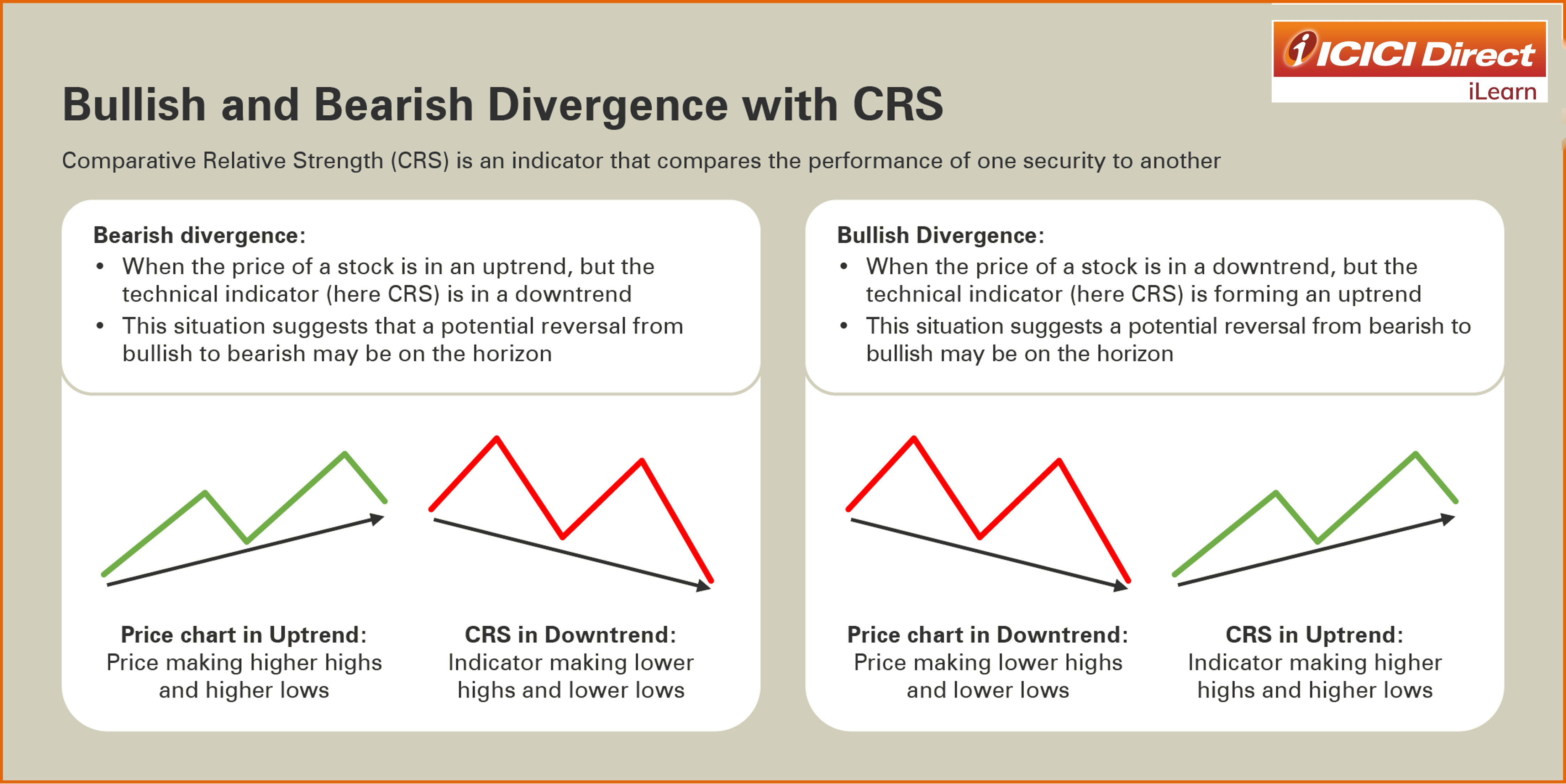
A bullish divergence in the CRS signals relative strength during a price decline. Alternatively, a bearish divergence in the CRS indicates weakness during an uptrend in the price chart of the stock. This approach is the most effective in analysing CRS and looking for potential reversal signs in the price chart of the stock.
What is a divergence, though, is a question you might ask.
Bullish and bearish divergences are technical analysis concepts used to identify potential trend reversals. These divergences occur when the price of a security moves in the opposite direction of a technical indicator. In our case, the technical indicator is the Comparative Relative Strength.
A bullish divergence occurs when the price of a stock is in a downtrend, but the technical indicator (here CRS) is forming an uptrend. This suggests that although the price is still in a downtrend, the momentum behind the price movement is weakening, and a potential reversal may be on the horizon.
On the other hand, a bearish divergence occurs when the price of a stock is in an uptrend, but the technical indicator (here CRS) is in a downtrend. This suggests that although the price is still in an uptrend, the momentum behind the price movement is weakening, and a potential reversal may be on the horizon.

A bearish divergence in the Comparative Relative Price signals relative weakness during an uptrend in the price chart of the stock. For example, the chart above shows DMART with the Price Relative to ITC. As you can see the price chart of Dmart has been in an uptrend from May 2021 to Sep 2021, however, the price relative chart has been in an uptrend during the same period. This demonstrates that there was a bearish divergence because the price relative chart did not support the upward trend in the price chart. The two charts' bearish divergence is a warning indicator that the price of Dmart may be about to reverse. Notice that Dmart reached its high point on September 20, 2022, and it has since been in a decline, which is consistent with the trend in the price relative chart.
Summary
- The CRS can help you narrow your investment options by comparing the relative strength of different assets and identifying which is performing better.
- The Comparative relative strength indicator is calculated by dividing the price of one security or market index by the price of another security or market index.
- A basic trend analysis can help you determine the direction of CRS. One can also use a preferred moving average indicator to analyse the CRS chart.
- A bullish divergence in the CRS signals relative strength during a price decline. On the other hand, a bearish divergence in the CRS indicates weakness during an uptrend in the stock price chart.
- CRS should not be used in isolation but in conjunction with other indicators and analyses to make informed investment decisions.






Please Enter Email


 70 Years
 4.4 Star

COMMENT (0)