





Learning Modules Hide
Hide
- Chapter 1: Power of Combined Technical Indicators – Part 1
- Chapter 2: Power of Combined Technical Indicators – Part 2
- Chapter 3: Directional Movement System
- Chapter 4: Rate of Change Indicator (ROC)
- Chapter 5: Comparative Relative Strength Indicator
- Chapter 6: Types of Market Days – Part 1
- Chapter 7: Types of Market Days – Part 2
- Chapter 8: Pivot Points - Part 1
- Chapter 9: Pivot Points – Part 2
- Chapter 10: Value Area Trading – Part 1
- Chapter 11: Value Area Trading – Part 2
- Chapter 1: Introduction to Technical Analysis
- Chapter 2: Introduction to Charts and Chart Types
- Chapter 3: Trends, Support, and Resistances
- Chapter 4: Breakouts, Stops and Reversals
- Chapter 5: Fibonacci Retracements
- Chapter 6: Candlestick Patterns - One and Two Candle Patterns
- Chapter 7: Candlestick Patterns: Three Candle Patterns
- Chapter 8: Chart Patterns
- Chapter 9: Moving Averages and Crossovers
- Chapter 10: Price Volume Confirmation
- Chapter 11: Technical Indicators - Part 1: MACD and Stochastics
- Chapter 12: Technical Indicators - Part 2: Bollinger Bands and Relative Strength Index (RSI)
- Chapter 13: Do’s and Don’ts for Effective Trading Using Technical Analysis

Chapter 7: Types of Market Days – Part 2
Imagine the stock market as a big puzzle with various pieces. In the last part of understanding market days, we learned about some pieces, like Trend Days and Double Distribution Trend Days. Now, we're diving into more pieces like Expanded Typical Days, Trading Range Days, and Sideways Days. Each new piece we find helps us solve the puzzle of the market, making it easier to navigate and make wise decisions, even when things feel puzzling.
1. The Expanding Typical Day
An Expanded Typical Day shares similarities with a Typical Day but involves a wider initial balance and greater price volatility.
In a market with an Expanded Typical Day, the trading session usually begins with a substantial price rally or sell-off, creating a broad initial balance. This wide initial balance is established early in the trading day and sets the stage for increased volatility. The initial movement often results from reactions to significant economic news or events.
After the initial rally or sell-off, responsive participants enter the market, pushing prices in the opposite direction and establishing the day's trading extremes. The market then tends to trade within these extremes for the remainder of the session.
While a Typical Day is characterized by a balanced market with moderate trading activity, an Expanded Typical Day introduces higher volatility and a wider trading range. Traders may need to adapt their strategies to navigate the increased price fluctuations and capitalize on potential opportunities within this market environment.
The key differences between a Typical Day and an Expanded Typical Day are:
Typical Day
- Wide Initial Balance: Starts with a wide initial balance resulting from a sharp rally or sell-off.
- Responsive Participants: Responsive participants push prices in the opposite direction, establishing trading extremes.
- Quiet Trading: The market trades quietly within the established extremes for the rest of the session.
Expanded Typical Day
- Moderate Initial Balance: Involves a moderate initial balance, leading to increased volatility, and susceptible to a violation later in the session
- Early Market Movement: Typically begins with a substantial price rally or sell-off in response to significant economic news or events.
Frequent violations: The lower and upper boundary of the initial balance could be easily violated as buyers and sellers attempt to push the price toward their own perceived levels of value.

The figure above is a 4-hour Nifty50 chart illustrating a common Expanded Typical Day. Notice the initial balance was wider than what we usually see on a Double-Distribution Trend Day, but not as wide as a Typical Day. This less-wide range/initial balance suggests a chance of things going wrong at some point during the day, maybe at the extremes. In this case, sellers took charge and pushed prices down after overwhelming the lower end of the initial balance. This selling pressure made the overall range of the day expand, giving it its name. The ongoing selling pressure kept prices weak for the rest of the day, establishing a lower value.alue.
Trading strategies for Expanding Typical Day
As this day occurs in response to major news event, earnings, or global market movement, you can capitalize on the trade using swing trading strategies. But simultaneously it’s important to manage your risk due to increased volatility in such a setup.
Mean-Reversion Strategies: Consider mean-reversion strategies, buying near support and selling near resistance.
2. Trading Range Day
A Trading Range Day is a type of market day characterized by price movements occurring within a relatively defined range. Unlike trend days where prices move strongly in one direction, or typical days with a wide initial balance, a Trading Range Day sees the market oscillating back and forth, testing both support and resistance levels.
In this type of market situation, envision a seesaw in action. Buyers and sellers act like participants on opposite ends of the seesaw, with price fluctuations resembling the up-and-down motion. When the price swings to one extreme, responsive sellers’ step in, initiating downward movement and bringing the price back towards the day's lows. Conversely, responsive buyers enter the scene when the price reaches the opposite extreme, pushing it back towards the day's highs. This seesaw-like interaction continues until the trading session concludes, much like the seesaw's motion settling when playtime ends.
Key Features of a Trading Range Day
- Price Oscillation: Market prices fluctuate within a set range, with neither strong bullish nor bearish dominance.
- Balanced Buying and Selling: Buying and selling pressures are relatively equal, resulting in a lack of a clear trend.
- Testing Support and Resistance: The market often tests both support (lower boundary) and resistance (upper boundary) levels within the established range.
- Consolidation Patterns: Recognizable consolidation patterns may form, offering potential breakout or breakdown opportunities.
- Moderate Volume and Volatility: Compared to trend days, Trading Range Days typically exhibit moderate volume and volatility.
- Fair Trade Facilitation: Price movements within the range facilitate fair trade, allowing traders to buy at support levels and sell at resistance levels.
Trading Strategies for a Trading Range Day
- Range-Bound Trading: Identify and trade within the established range, using support and resistance levels.
- Breakout/Breakdown Trading: Look for potential breakouts or breakdowns from consolidation patterns within the trading range, implementing tight targets and stops.
- Mean-Reversion Strategies: Consider mean-reversion strategies, buying near support and selling near resistance.
- Patience and Selectivity: Since the market lacks a strong trend, traders may opt to remain patient and selective, waiting for favourable opportunities.
The figure below shows a daily candlestick chart of ITC Ltd:

Notice that the initial balance was quite broad at the beginning of the session, indicating a strong foundation to potentially sustain the day's trading activity. As prices moved towards the upper limit of the range, a strong resistance zone was formed, prompting sellers to perceive the price as overvalued. This led them to enter the market with sell orders, effectively pushing the price downward. Conversely, as prices approached the lower end of the range, forming a support zone, responsive buyers identified value and entered the market with buy orders, resulting in an upward movement of prices. Therefore, such days are typically favourable for active intraday traders.ers.
3. Sideways Day
A Sideways Day, also known as a Consolidation Day, occurs when the market experiences limited overall price movement, resembling a horizontal or sideways trend. During such days, the forces of buying and selling are in equilibrium, resulting in a balanced market. This type of session usually occurs ahead of the release of a major economic report or news event, or in advance of a trading holiday. Picture it like a calm lake, where the waters are still, and the market neither makes significant upward nor downward movements.ents.
Key Characteristics of a Sideways Day
- Lack of Clear Trend: Unlike Trend Days, where the market shows a strong directional bias, a Sideways Day lacks a distinct trend. Prices move within a confined range.
- Equal Buying and Selling Pressure: Buyers and sellers are relatively balanced, preventing any sustained and dominant market direction.
- Consolidation Patterns: Recognizable chart patterns, such as triangles or rectangles, may form as the market consolidates. Traders often anticipate potential breakouts from these patterns.
- Low Volatility: Compared to other market days, Sideways Days typically exhibit lower volatility, with price fluctuations occurring within a narrow range.
- Challenges for Trend Followers: Traders employing trend-following strategies may find Sideways Days less favourable, as there is no clear trend to capitalize on.
- Opportunities for Range Traders: On the flip side, range-bound traders may identify opportunities within the established price range, buying at support and selling at resistance.
Understanding and recognizing a Sideways Day is crucial for traders, as different strategies are required to navigate and potentially profit from the unique dynamics presented by this type of market day. Not every day is meant for trading. Traders who learn to stay on the sidelines avoid losses, a crucial aspect in distinguishing profitable from losing traders. Success often hinges on minimizing unprofitable days by trading only in favourable market conditions.

The above chart is an hourly chart of Indian Energy Exchange showing the trade activity before and after the quarterly earnings release. From the figure above, we can see that the market lacks conviction and tracks from 124 to 127 three days before the earnings release. The magnitude of the bars is small throughout all three days. There is low market participation as there is no initiative buying or selling pressure just ahead of a quarterly result release. However, after the earnings announcement, there is sudden spike in trading volume and price movement due to favourable financial results of the company.
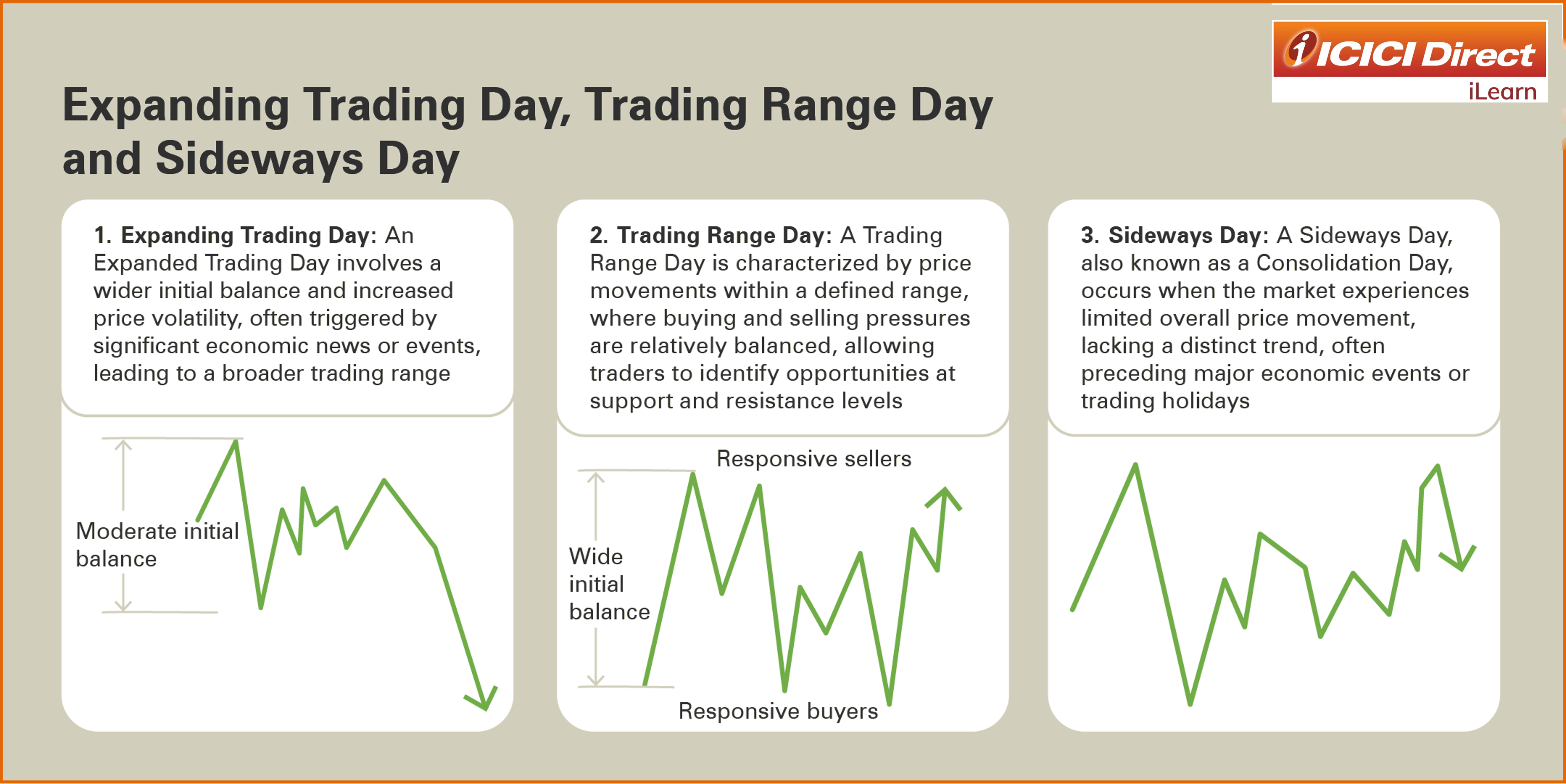
Summary
- Understanding the characteristics of each trading day allows traders to optimize their trading approach for maximum effectiveness.
- On an Expanded Typical Day, the market experiences moderate initial balance and increased price volatility, often triggered by significant economic news or events. Traders must adjust their strategies to navigate the higher price fluctuations and capitalize on potential opportunities.
- A Trading Range Day is when prices move within a defined range, fluctuating between support and resistance levels. Traders can use range-bound, breakout/breakdown, and mean-reversion strategies to profit from price fluctuations within an established range.
- A Sideways Day occurs when the market shows limited overall price movement, resulting in a balanced market with no clear trend. Traders can recognize consolidation patterns and anticipate potential breakouts. However, they may stay on the sidelines on such days to minimize losses and wait for more favourable trading conditions.
In the next chapter, we will understand the Pivot Point indicator commonly used in trading to determine potential support and resistance levels for a given time frame.






Please Enter Email


 70 Years
 4.4 Star

COMMENT (0)