





Learning Modules Hide
Hide
- Chapter 1: Power of Combined Technical Indicators – Part 1
- Chapter 2: Power of Combined Technical Indicators – Part 2
- Chapter 3: Directional Movement System
- Chapter 4: Rate of Change Indicator (ROC)
- Chapter 5: Comparative Relative Strength Indicator
- Chapter 6: Types of Market Days – Part 1
- Chapter 7: Types of Market Days – Part 2
- Chapter 8: Pivot Points - Part 1
- Chapter 9: Pivot Points – Part 2
- Chapter 10: Value Area Trading – Part 1
- Chapter 11: Value Area Trading – Part 2
- Chapter 1: Introduction to Technical Analysis
- Chapter 2: Introduction to Charts and Chart Types
- Chapter 3: Trends, Support, and Resistances
- Chapter 4: Breakouts, Stops and Reversals
- Chapter 5: Fibonacci Retracements
- Chapter 6: Candlestick Patterns - One and Two Candle Patterns
- Chapter 7: Candlestick Patterns: Three Candle Patterns
- Chapter 8: Chart Patterns
- Chapter 9: Moving Averages and Crossovers
- Chapter 10: Price Volume Confirmation
- Chapter 11: Technical Indicators - Part 1: MACD and Stochastics
- Chapter 12: Technical Indicators - Part 2: Bollinger Bands and Relative Strength Index (RSI)
- Chapter 13: Do’s and Don’ts for Effective Trading Using Technical Analysis

Chapter 4: Rate of Change Indicator (ROC)
Imagine momentum in trading as the force you apply to a rolling snowball. Initially, it's small and slow, but as you keep pushing, it gathers more snow and speed, rolling faster downhill. Similarly, in trading, momentum reflects the strength and speed of price movements. When momentum is strong, prices accelerate, just like the snowball rolling downhill. When momentum slows or reverses, it's like the snowball losing speed or changing direction, signalling potential shifts in market trends.
Understanding ROC
The Rate of Change (ROC) indicator in trading is like measuring how quickly the snowball is gaining or losing speed. It calculates the percentage change in price over a specified period, showing the rate at which prices are accelerating or decelerating.
Just as you'd use the snowball's speed to anticipate its path, traders use ROC to gauge the strength of price trends. A high ROC suggests strong momentum, indicating potential buying or selling opportunities. Conversely, a low ROC could signal a slowdown in momentum, prompting traders to be cautious of trend reversals.
How does ROC work?
The Rate of Change (ROC) indicator measures the percentage change in price between the current price and the price a certain number of periods ago. It's calculated using the following formula:
ROC = ((Current Price – Price “n” periods ago) / Price “n” periods ago) x 100
Here, "n" represents the number of periods, which could be days, weeks, months, etc.
For example, so a 20-day ROC will be calculated as:
Today’s Close = Rs. 350; n = 20 days
Close 20 Days Ago = Rs. 280
Therefore, ROC = ((350 – 280) / 280) x 100 = 25%
So, with a 20-day ROC value of 25%, it suggests that the price has gained momentum, rising by 25% over the past 20 days.

How to interpret the ROC indicator?
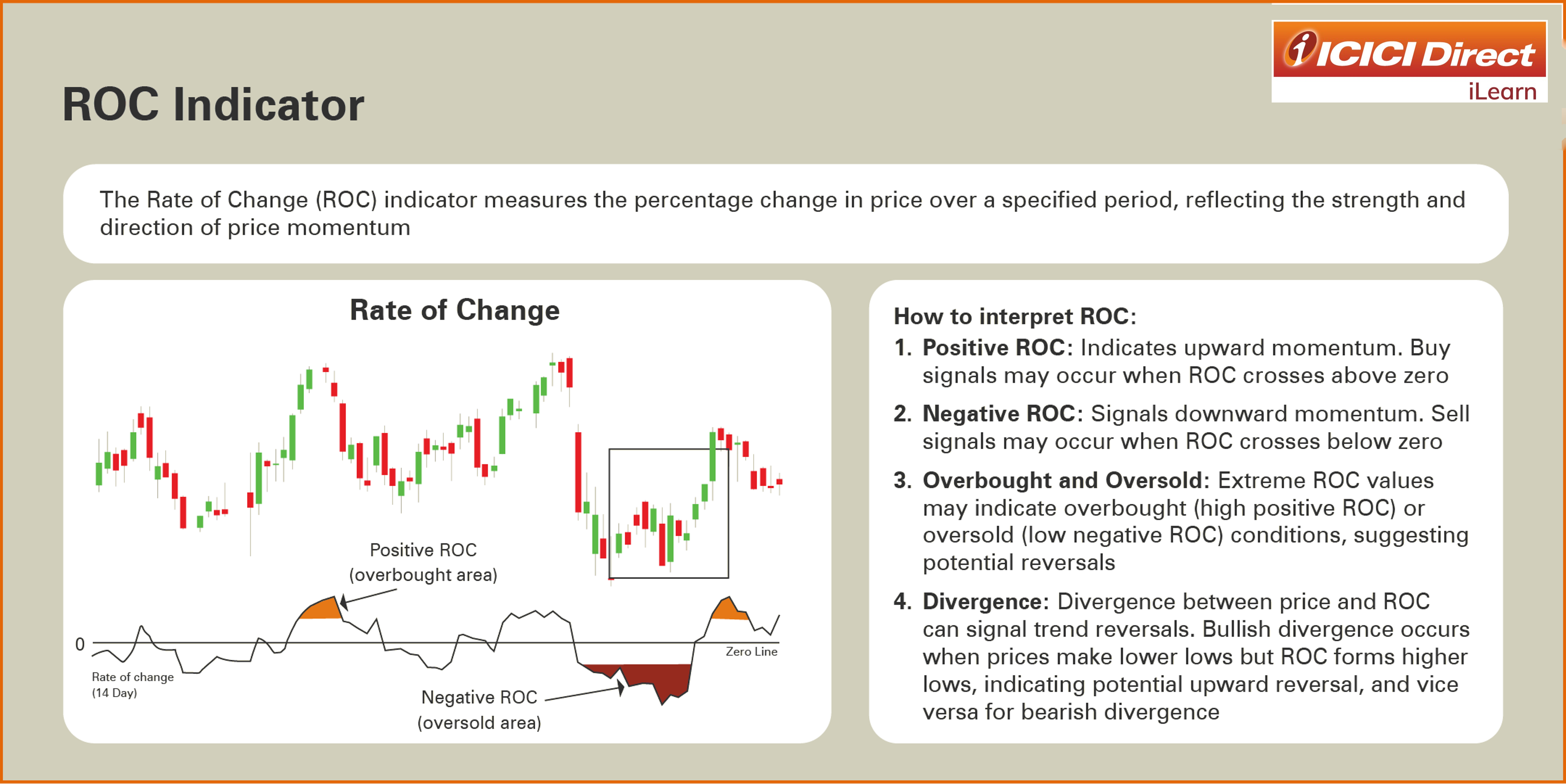
Interpreting the ROC indicator involves understanding its graphical representation as an oscillator. It fluctuates above and below a centreline, usually positioned at zero. When price changes are positive (to the upside), the ROC moves into positive territory, and when price changes are negative (to the downside), it moves into negative territory.
Interpreting the Rate of Change (ROC) indicator involves understanding its values and how they reflect the momentum of price movements.
Magnitude of ROC
The magnitude of the ROC value reflects the intensity of price changes over the specified period, thereby assessing the strength of the momentum. Higher absolute values, whether positive or negative, indicate faster and more significant price movements. For example, a large positive ROC suggests strong upward momentum, while a large negative ROC indicates strong downward momentum.
Trend Strength
ROC can help traders assess the strength of a trend. Rising ROC values indicate increasing momentum in the direction of the trend. For an uptrend, increasing positive ROC values suggest strengthening bullish momentum, while for a downtrend, increasing negative ROC values suggest strengthening bearish momentum. Conversely, declining ROC values may indicate weakening momentum and the possibility of a trend reversal.
Overbought and Oversold Conditions
Extreme ROC values can signal overbought or oversold conditions in the market. A very high positive ROC may suggest that prices have risen too quickly and that the asset is overbought, potentially leading to a pullback or reversal. Conversely, a very low negative ROC may indicate that prices have fallen too rapidly and that the asset is oversold, possibly signalling a bounce-back or reversal to the upside.
Key points to remember
- The choice of time period for ROC influences the frequency of signals generated.
- Shorter periods, such as 10 days, result in more frequent signals, whereas longer periods, like a 20-day ROC, highlight stronger, sustained trend changes.
- Comparing ROC across different timeframes, such as 10-day and 20-day ROC, offers a broader perspective on trend momentum.
- Agreement in ROC signals between different timeframes suggests a stronger overall trend, while conflicting signals may indicate a weakening trend and potential reversal.
- ROC serves as a leading oscillator, aiding in the identification of stocks with significant momentum, which often outperform the market in the short term.
- Utilizing ROC helps traders identify areas where the market is either slowing down or gaining momentum, assisting in decision-making processes related to stock selection and market timing.
|
Did you know? The Rate of Change (ROC) indicator is not limited to measuring price changes in financial markets. It is also used in fields like physics and environmental science to analyse rates of change in various phenomena. In physics, it can assess changes in velocity or acceleration, while in environmental science, it can track changes in environmental factors like temperature or pollution levels. |
Trading strategies using ROC Indicator
Incorporating moving averages with ROC can enhance signal confirmation. For example, using a combination of short-term and long-term moving averages with ROC can help identify entry and exit points in trades.

The image above is an hourly chart of Axis Bank, wherein I have used the 5-day Simple Moving Average (purple line), 30-day Simple Moving Average (black line) & ROC.
The Moving Average & ROC strategy is very simple- whenever 5 SMA is above 30 SMA and whenever the ROC goes above the zero line from below, you should go long, and vice-versa for a short position.
You can take a long position at the level of 984 when ROC started picking momentum and went above the zero line. You can see that at this point the 5-SMA crosses above 30-SMA, giving us more confirmation to go long at this point. You can make an exit when the ROC reverses and starts declining and the 5-SMA also reverses. So, we exit at 1029, making a 4.6% profit.
When ROC went below the zero line and 5 -day SMA also crossed below 30-day SMA at 1029, either you short or sell or stay out of the trade. You may re-enter when the situation reverses, i.e., the 5-SMA crosses above 30 SMA and the ROC also turns positive.
You will observe that at 997, you again get a buy signal and the sell signal for this trade only came to 1121, after which the market went into a consolidation phase as can be seen by the almost flat 30 SMA and the ROC hovering around the zero line. In such a phase, you should ideally look for other indicators too to confirm an entry point as the ROC can trigger a lot of whipsaws while in the consolidation phase. Or it’s best to stay out and better find another stock that it’s in a clear trend.
Summary
- Rate of Change (ROC) is a momentum indicator that calculates the speed of price changes, indicating the strength and steepness of trends.
- Understanding momentum in trading is akin to pushing a snowball, where increasing momentum signifies faster price movements.
- ROC measures the percentage change in price over a specified period, aiding traders in gauging trend strength and potential opportunities.
- Interpreting ROC involves analysing its magnitude, trend strength, and overbought/oversold conditions to make informed trading decisions.
- Different timeframes for ROC can impact signal frequency and strength, with shorter periods generating more frequent signals and longer periods highlighting sustained trend changes.






Please Enter Email


 70 Years
 4.4 Star

COMMENT (0)