





Learning Modules Hide
Hide
- Chapter 1: Power of Combined Technical Indicators – Part 1
- Chapter 2: Power of Combined Technical Indicators – Part 2
- Chapter 3: Directional Movement System
- Chapter 4: Rate of Change Indicator (ROC)
- Chapter 5: Comparative Relative Strength Indicator
- Chapter 6: Types of Market Days – Part 1
- Chapter 7: Types of Market Days – Part 2
- Chapter 8: Pivot Points - Part 1
- Chapter 9: Pivot Points – Part 2
- Chapter 10: Value Area Trading – Part 1
- Chapter 11: Value Area Trading – Part 2
- Chapter 1: Introduction to Technical Analysis
- Chapter 2: Introduction to Charts and Chart Types
- Chapter 3: Trends, Support, and Resistances
- Chapter 4: Breakouts, Stops and Reversals
- Chapter 5: Fibonacci Retracements
- Chapter 6: Candlestick Patterns - One and Two Candle Patterns
- Chapter 7: Candlestick Patterns: Three Candle Patterns
- Chapter 8: Chart Patterns
- Chapter 9: Moving Averages and Crossovers
- Chapter 10: Price Volume Confirmation
- Chapter 11: Technical Indicators - Part 1: MACD and Stochastics
- Chapter 12: Technical Indicators - Part 2: Bollinger Bands and Relative Strength Index (RSI)
- Chapter 13: Do’s and Don’ts for Effective Trading Using Technical Analysis

Chapter 10: Value Area Trading – Part 1
Value Area Trading is a methodology used by traders to identify significant price levels within a given trading session. It is based on the concept of market profile, which visualizes the distribution of trading activity over time. The key component of Value Area Trading is the "value area," which represents the price range where the majority of trading volume occurs during a specific period, typically a trading session.
Imagine stepping into a bustling marketplace, where vendors and buyers interact, each transaction contributing to the market's overall activity. In this marketplace, certain areas attract more attention and activity, indicating their significance. Similarly, in Value Area Trading, we observe the ebb and flow of trading volume to pinpoint these critical zones.
What is Value Area Trading?
To understand Value Area Trading, we must start with market profile analysis and Point of Control (POC).
-
Market Profile Analysis:
Market profile analysis is a technique used by traders to visualize the distribution of trading activity over time. It organizes price and volume data into a graphical representation, typically displayed as horizontal bars (or "TPOs") on a chart. These bars represent the amount of trading activity that occurred at each price level during a specific period, offering insights into where buyers and sellers are most active.
-
Point of Control (POC):
Within the market profile, the Point of Control (POC) is the price level at which the most trading activity occurred during the specified period. It serves as a reference point for traders, indicating the price level that attracted the highest volume of trading. The POC is significant because it often acts as a magnet for price, attracting trading activity and potentially serving as a support or resistance level.
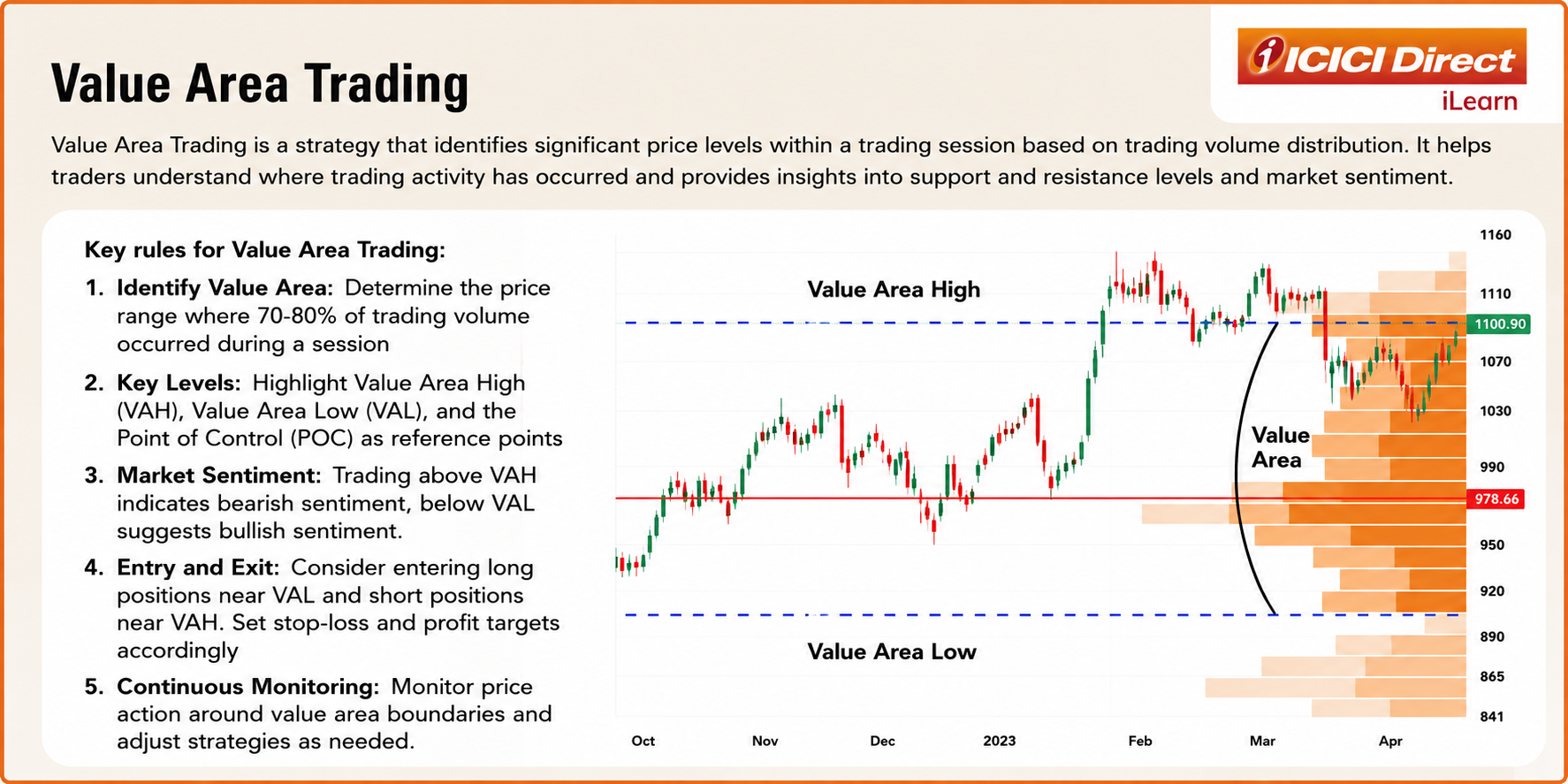
- Finally, Value Area Trading builds upon these two concepts as it’s a trading strategy that utilizes market profile analysis to identify significant price levels within a trading session. It focuses on determining the value area, which is the price range containing the majority of trading volume for the specified period, typically around 70% to 80% of the total volume. Within the value area, traders identify the upper boundary (Value Area High - VAH), lower boundary (Value Area Low - VAL), and the POC.
- Volume Profiles analyse how much trading activity occurred over time, whereas Market Profiles consider how much time was spent at each price level.

Source: TradingView
|
Did you know? Value Area Trading was popularized by J. Peter Steidlmayer, a trader who worked at the Chicago Board of Trade. Steidlmayer developed the market profile concept, which is the foundation of Value Area Trading, in the 1980s. His work revolutionized how traders analyse and understand market dynamics, leading to the development of various trading strategies based on market profile analysis. |
Breaking down the Value Area Strategy
-
Value Area High (VAH):
The Value Area High represents the upper boundary of the value area, which is the price range containing the majority of trading volume for a given period, typically around 70% to 80%. It signifies the highest price level within this range where trading activity is concentrated. Traders pay close attention to VAH as it serves as a resistance level, where selling pressure may increase, potentially leading to a reversal in price direction. If the market breaks above VAH, it could indicate a bullish breakout and the potential for further upward momentum.
-
Value Area Low (VAL):
Conversely, the Value Area Low represents the lower boundary of the value area. It denotes the lowest price level within the range where trading volume is concentrated. VAL acts as a support level, where buying interest may strengthen, potentially causing a reversal or bounce in price. Traders monitor VAL closely for signs of price action, such as bullish reversals or trend continuation patterns, to capitalize on potential trading opportunities. A break below VAL could signal a bearish breakout and the potential for further downward movement.
-
Value Area Point of Control (VPOC):
The Value Area Point of Control (VPOC) is the price level within the value area where the highest trading volume occurs. It represents the most traded price level during the specified period and serves as a significant reference point for traders. VPOC acts as a magnet for price, attracting trading activity and serving as a support or resistance level depending on its location relative to the current market price. Traders use VPOC to gauge market sentiment and identify potential areas of price equilibrium or imbalance. A strong deviation from VPOC could indicate a shift in market dynamics, with potential trading opportunities arising as a result.
- The blue and yellow histograms represent buy and sell trading volume, respectively.
Example
Here is a brief overview of how the Volume Profile can be used:
- Identify support and resistance levels
- Determine a fair price for the asset
- Predict potential trend reversals
- Determine if the market is balanced or imbalanced
We will use the VPVR (Volume Profile Visible Range) indicator which measure volume profile to understand the concept better.
Before spotting Volume Profile patterns, we need to adjust the VPVR indicator settings. Increasing the number of bars, such as to 150, provides a more detailed histogram, offering a clearer visualization of trading volume distribution.
Utilize the Point of Control (POC) line as support and resistance, and both high and low-volume nodes can also serve as support and resistance levels. High-volume nodes often precede a brief consolidation period due to increased trading activity.
The blue and yellow histograms represent buy and sell trading volume, respectively.


If we look at the hourly chart, the downtrend that began on 25th July seems to be supported when the price first broke the Value Area High to proceed towards the POC line, which was also broken later, around August 18th, as shown on both charts.
Pro tip - The 80% Rule: The 80% Rule states that if the stock price opens above/below the value area but retraces to the value area twice within two consecutive 30-min candlesticks, there's an 80% probability of the value area being filled. For instance, if the stock price retraces to the value area from above with two consecutive 30 min candlesticks remaining inside the value area, then there is a 80% probability of a downtrend till the value area is completely filled.
Other ways of identifying Value areas on a price chart-
-
Volume-Weighted Average Price (VWAP):
VWAP is valuable for identifying value areas because it reflects significant trading volume at specific price levels. Since VWAP considers volume, it emphasizes price levels with higher trading activity, which are typically viewed as areas of value. These levels represent where numerous traders have executed trades, indicating a consensus on the asset’s value at those prices.
Read More: A Complete Guide on VWAP
-
Fibonacci Retracement Levels:
The Fibonacci retracement tool is based on the premise that markets follow predictable patterns. By identifying major high and low points on a price chart, traders can apply Fibonacci ratios to predict potential areas of support or resistance. These levels often align with value areas, as they denote points where the market perceives the price as attractive, resulting in increased buying or selling activity. Additionally, Fibonacci levels frequently serve as key levels due to their widespread use by traders.
Read More: Learn Fibonacci Retracements
Summary
- Volume profile aggregates trading volume within a specific timeframe, establishing value areas.
- The Value Area represents where 70% of the volume has traded.
- The Volume Point of Control (VPOC) denotes the price with the highest volume.
- In strong trends, traders can utilize the VPOC as a support level for buying dips.
- If you're in a long position (buying), consider placing your stop-loss just below the VAL. This level acts as a support zone, so if the price breaks below it, it may indicate a reversal in trend, and you'd want to exit the trade to protect your profits. Similarly, if you're in a short position (selling), you might set your stop-loss just above the VAH, as this level acts as resistance.
In the next chapter, we will delve deeper into the intricacies of volume profile and its application in crafting effective trading strategies.






Please Enter Email


 70 Years
 4.4 Star

COMMENT (0)