





Learning Modules Hide
Hide
- Chapter 1: Power of Combined Technical Indicators – Part 1
- Chapter 2: Power of Combined Technical Indicators – Part 2
- Chapter 3: Directional Movement System
- Chapter 4: Rate of Change Indicator (ROC)
- Chapter 5: Comparative Relative Strength Indicator
- Chapter 6: Types of Market Days – Part 1
- Chapter 7: Types of Market Days – Part 2
- Chapter 8: Pivot Points - Part 1
- Chapter 9: Pivot Points – Part 2
- Chapter 10: Value Area Trading – Part 1
- Chapter 11: Value Area Trading – Part 2
- Chapter 1: Introduction to Technical Analysis
- Chapter 2: Introduction to Charts and Chart Types
- Chapter 3: Trends, Support, and Resistances
- Chapter 4: Breakouts, Stops and Reversals
- Chapter 5: Fibonacci Retracements
- Chapter 6: Candlestick Patterns - One and Two Candle Patterns
- Chapter 7: Candlestick Patterns: Three Candle Patterns
- Chapter 8: Chart Patterns
- Chapter 9: Moving Averages and Crossovers
- Chapter 10: Price Volume Confirmation
- Chapter 11: Technical Indicators - Part 1: MACD and Stochastics
- Chapter 12: Technical Indicators - Part 2: Bollinger Bands and Relative Strength Index (RSI)
- Chapter 13: Do’s and Don’ts for Effective Trading Using Technical Analysis

Chapter 3: Directional Movement System
Imagine you're on a road trip with hills and valleys. Some roads go up steep hills, while others have gentler slopes. You can see if the road goes up or down, but understanding how steep it is can affect your journey & driving style. Similarly, in the stock market, it's easier to tell if things are going up (bullish) or down (bearish), but knowing how strong these movements are is important. That's where tools like the Directional Movement Index (DMI) and the Average Directional Index (ADX) come in.
It's a bit like using a map that shows how steep roads are before you plan your trip. Traders use the DMI and ADX to understand how powerful market trends are. These tools help traders make better choices about when to trade and when to wait.
This chapter explains how the DMI and ADX work, how traders use them to make decisions, and why they're so helpful in the stock market.
Understanding DMI
The Directional Movement Index (DMI) is a technical analysis indicator developed by J. Welles Wilder, which unlike a lot of indicators that you see on the market this does not necessarily measure overbought and oversold conditions rather it indicates strength of trend or lack thereof.
Most indicators have limitations, either they work in trending or ranging markets. DMI's standout feature is its ability to identify a market's trend before signalling trading opportunities. This indicator comprises two lines:
- The Positive Direction Indicator (+DI) reflects upward trend movement by calculating the difference between today’s high and yesterday’s high, aggregated over the past 14 periods.
- The Negative Direction Indicator (-DI) represents downward trend movement, showing the difference between today’s low and yesterday’s low, also aggregated over the past 14 periods.
Both +DI and -DI are plotted on the chart and fluctuate between 0 and 100. The relationship between +DI and -DI can offer signals to traders:
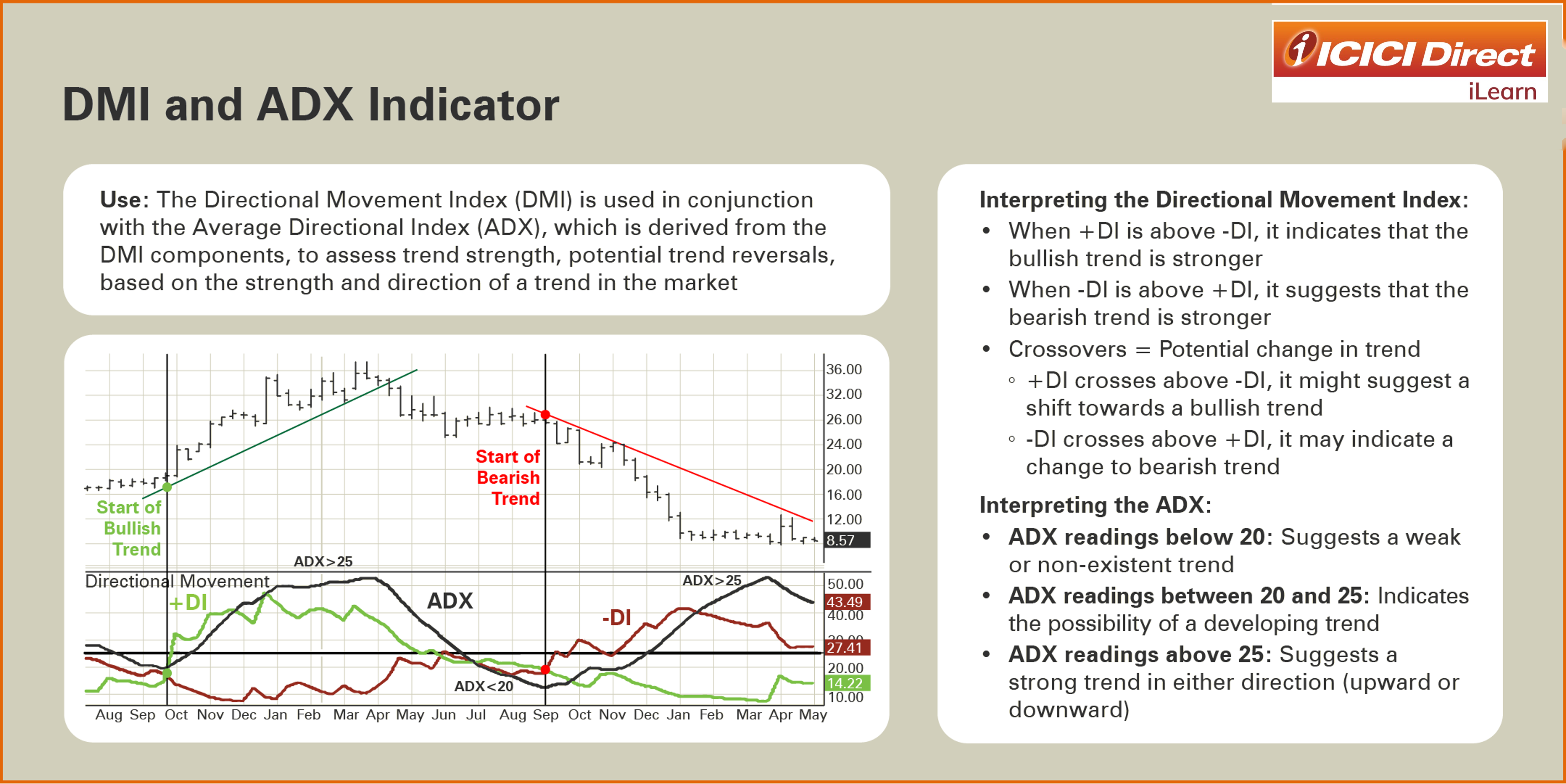
- When +DI is above -DI, it indicates that the bullish trend is stronger.
- When -DI is above +DI, it suggests that the bearish trend is stronger.
- Crossovers between +DI and -DI may signal potential changes in trend direction. For example, if +DI crosses above -DI, it might suggest a shift towards a bullish trend, and vice versa.
 source: https://commodity.com/technical-analysis/dmi/
Wilder devised a straightforward system utilizing these indicators, creating the Directional Movement System with -DMI, +DMI, and the Average Directional Index (ADX).
Deconstructing the ADX indicator
The Average Directional Index (ADX) is designed to measure the strength and momentum of a trend, whether it's an uptrend or downtrend. ADX is considered a “non-directional” lagging indicator, meaning that a trend must already be established before the index can generate its signal.
The ADX itself doesn't directly incorporate the +DI and -DI values. Instead, it uses these values to calculate a single line, the ADX line, which represents the strength of the trend, regardless of its direction (bullish or bearish).
Both ADX and DMI operate on a scale of zero to 100. So, the stronger the trend, the larger the reading regardless of whether it is an uptrend or downtrend.
We use this indicator to determine whether a trend following or range trading strategy should be used. For example, if you're going to use a trend following system, moving averages can be used. If you're going to use a range trading methodology, take a look at something like the stochastic oscillator or one of the other momentum tools.
Simply put, if the ADX Line is
- Below 20: The market is currently not trending
- Crosses above 20: A new trend is emerging
- Between 20 and 40: Confirms an emerging trend
- Above 40: Signals a robust trend
- Crosses 50: Signifies an extremely strong trend
- Crosses 70: An infrequent power trend
Trading Rules for combining DMI & ADX
Trend Confirmation
-
Enter a trade when +DI crosses above -DI and the ADX indicates a strengthening trend (ADX above 25 or 30).
- For a short trade, enter when -DI crosses above +DI and the ADX suggests a strengthening downtrend.
Trend Continuation
-
Consider adding to or holding positions as long as the +DI remains above -DI and the ADX indicates a robust trend (ADX remains high).
- For short trades, consider adding to positions when -DI remains above +DI and the ADX indicates a strong downtrend.
Exit Strategy
-
Exit or consider taking profits when +DI crosses below -DI or when the ADX begins to decline, indicating a potential weakening trend.
- · For short trades, exit when -DI crosses below +DI or when the ADX starts declining.
Risk Management
- Now once ADX starts rising above the 80 marks, that is between 80 and 100, avoid considering it and wait for it to cool off as it suggests excess in trend over short-term.
- Implement stop-loss orders based on the strength of the trend. Tighten stops during consolidating markets (low ADX) and widen stops during strong trends (high ADX).

So, this is an extremely simple trading strategy which works exceptionally well for swing trading. We have taken a weekly time frame chart for Axis Bank to explain the long strategy. We have taken a 20-period exponential moving average and DMI indicator (with default setting of ADX as 14). The strategy has 4 simple rules.
- Rule number one, ADX Indicator 14 on daily timeframe must be above 30 and rising, indicating a strong trend.
- Rule number two, look for a retracement of price towards 20-day exponential moving average. Now while retracement is happening ADX Indicator (14) may experience some dip, that is, you see here ADX Indicator is heading down while being above 30. Now, this is totally fine.
- Rule number three, when price touches the 20 EMA, look at this candle here, it is touching the 20 EMA, buy next day or on the following sessions, where high of this candle which was touching the 20 EMA, is crossed. So, you wait for the price to pull back to 20-day EMA, and once a candle touches this 20-day EMA, take the high of the candle, draw a horizontal line, and wait for this high be crossed in subsequent candles. As soon as this high is crossed you enter the trade.
- Rule number four is to keep the stop loss at the recent swing low.
The short strategy rules are also similar.
- The first rule is that the ADX Indicator 14 has to be above 30.
- Rule number two, when price is below the 20-exponential moving average (EMA), wait for the retracement to happen till 20 EMA.
- Rule number three, when price touches the 20-exponential moving average, short sell next day, or in subsequent sessions, if the low of the candle that touches 20 EMA is crossed on the downside.
- Rule number four is to put the stop-loss at the recent swing high that is formed.
Summary
- The DMI (ADX) is composed of three elements - the ADX, DI+, and DI-. The ADX quantifies the trend's strength, whereas DI+ and DI- indicate its direction.
- However, the DMI (ADX) has limitations, offering trend strength without directional information and potentially delivering delayed or inaccurate signals in specific market conditions.
- Combining the DMI (ADX) with additional technical indicators enhances market analysis.
- When contemplating a trend change, employing the ADX to validate trend strength and the DMI to ascertain trend direction proves more effective than attempting to navigate every peak and valley on a chart.
In the next chapter, we will learn about Rate of Change (ROC) momentum indicator, which measures the rate of price change to indicate trend strength and steepness.






Please Enter Email


 70 Years
 4.4 Star

COMMENT (0)