





Learning Modules Hide
Hide
- Chapter 1: Power of Combined Technical Indicators – Part 1
- Chapter 2: Power of Combined Technical Indicators – Part 2
- Chapter 3: Directional Movement System
- Chapter 4: Rate of Change Indicator (ROC)
- Chapter 5: Comparative Relative Strength Indicator
- Chapter 6: Types of Market Days – Part 1
- Chapter 7: Types of Market Days – Part 2
- Chapter 8: Pivot Points - Part 1
- Chapter 9: Pivot Points – Part 2
- Chapter 10: Value Area Trading – Part 1
- Chapter 11: Value Area Trading – Part 2
- Chapter 1: Introduction to Technical Analysis
- Chapter 2: Introduction to Charts and Chart Types
- Chapter 3: Trends, Support, and Resistances
- Chapter 4: Breakouts, Stops and Reversals
- Chapter 5: Fibonacci Retracements
- Chapter 6: Candlestick Patterns - One and Two Candle Patterns
- Chapter 7: Candlestick Patterns: Three Candle Patterns
- Chapter 8: Chart Patterns
- Chapter 9: Moving Averages and Crossovers
- Chapter 10: Price Volume Confirmation
- Chapter 11: Technical Indicators - Part 1: MACD and Stochastics
- Chapter 12: Technical Indicators - Part 2: Bollinger Bands and Relative Strength Index (RSI)
- Chapter 13: Do’s and Don’ts for Effective Trading Using Technical Analysis

Chapter 6: Types of Market Days – Part 1
Picture the stock market like a playlist – every trading day is a unique track, yet it carries echoes of familiar tunes. Understanding trader psychology unveils the secret, correlating each day with past patterns. Mastering the six types of market days enables traders to anticipate reversals, breakouts, offering guidance in navigating the ever-changing stock market. Just as no two days are alike, embracing these patterns provides a practical approach to interpreting the market's ebb and flow. The first three types — Trend Days, Double Distribution Trend Days, and Typical Days — set a foundational understanding. Subsequent chapters will explore the remaining types, providing insights to adapt and capitalize on diverse market dynamics.
1. The Trend Day
Picture a sprinter poised at the starting blocks of a 100-meter dash. The moment the race commences, the sprinter bolts, accelerating until reaching top speed and maintaining this pace until crossing the finish line. Similarly, a market day exhibiting a Trend Day surges powerfully from the start and sustains a one-directional movement throughout most of the trading session. This type of day showcases:
- Unidirectional Movement: Market moves resolutely in one direction with minimal retracements against the trend.
- Bullish or Bearish Trend Day: Typically, the open marks the day's low, closing near the day's high, and vice versa for a bearish Trend Day.
- Wide Price Range: These days possess the highest price range, potentially incurring substantial losses for those positioned against the market or failing to identify the pattern early.
- Infrequent Occurrence: Trend Days occur sparingly each month but capturing these moves can significantly boost profits.
- Preceding and Succeeding Behaviours: Usually, a quiet market day precedes a Trend Day, and a similar behaviour typically follows afterward.
- Strategies: Optimal strategies involve joining the prevailing trend on pullbacks, implementing trend-following tactics, and using stop-loss orders to safeguard against sudden reversals.
The figure below illustrates a bullish trend day for Nifty50 on 27th April, 2023 on an hourly chart:

The above chart shows how the market opens with a gap up and then moves rapidly in the direction of a new price point. The previous day was also mostly a quiet day with a spike at the end of the day. This type of quiet trading behaviour can usually tip you off to a potential Trend Day in the upcoming session. In the next session, you might have readily sensed that you could have a big day if you had kept your ear to the ground. Thus, signifying that understanding the signals the market continuously provides is the key to trading.
2. Double Distribution Trend Day
A Double Distribution Trend Day extends the characteristics of a regular trend day but lacks the confidence or conviction seen in a Trend Day. This day is marked by initial indecision and begins with a quiet market opening, with prices trading in a tight range for the first hour or two. This range sets the initial balance, serving as reference points for trade facilitation.
The Initial Balance (IB) refers to the price range established during the first trading hour or the initial trading period of a particular session. This range helps traders gauge the early market sentiment and can provide insights into potential price movements for the rest of the trading session. If the IB range is narrow, a breakout occurs easily, auctioning toward new value, creating range extension. After the range extension, the price again starting consolidating at a new value, forming a second price distribution. This double distribution manifests as distinct peaks, indicating high volume and price acceptance areas, with comparable interest from buyers and sellers.
Picture this like a well-built bridge, its strength hinging on the breadth of its foundation. A broad base ensures resilience against external forces, securing the structure's stability. Conversely, a narrow foundation invites instability, risking structural failure under pressure. In the stock market, a Double Distribution Day's narrow initial balance mirrors this analogy. The Double-Distribution Trend Day's narrow initial balance also suggests that eventually either the buyers or sellers will overpower the other. Price is driven by initiative market members, therefore once direction is determined, it will freely travel toward a new area of value.
- Distinct Peaks or Distributions: Notable price action forms two peaks or distributions, signifying high volume and price acceptance.
- Relatively Equal Peaks: Both distributions exhibit comparable volume and price acceptance, indicating similar interest from buyers and sellers.
- Movement Beyond Initial Balance: Market movement beyond the initial balance establishes two separate areas of price acceptance.
- Potential Shift in Sentiment: Suggests a potential shift in market sentiment, reflecting a struggle between buyers and sellers or a transitional market phase.
- Volume Confirmation: Equal volumes in both peaks validate the pattern's significance.
The figure below shows a 5-minute candlestick chart of Nift50 on 5th January, 2024:

As we can see from this chart, the market tightly consolidates near 21,720 and 21,740 for the first hour and half of the day. Then, when the price breaks out of the initial trading range, there is aggressive bearish behaviour before the market consolidates near 21,686. Since the initial balance was narrow, the initiative selling pressure caused the price to move lower and eventually formed second distribution and closed within these bounds.
Traders regard Double Distribution Days as potential precursors to shifts in market sentiment or trends, anticipating potential breakouts or breakdowns from established value areas.
3. Typical Day
A Typical Day in the stock market usually starts with a wide range of prices. This happens because of a sudden increase or decrease in prices, attracting traders to join in. After this initial movement, the market usually trades calmly within these high and low points, known as Initial Balance Low (IBL) and Initial Balance High (IBH), for the rest of the day. The early increase or decrease in prices is often a reaction to important news. This creates a stable foundation for the rest of the day, similar to how a wide base keeps a coffee table from tipping over. Throughout a typical day, the prices stay within the starting range, allowing fair trading. So, when the market opens on a typical day, it has a broad price range. As the day goes on, the prices usually narrow down towards the closing time.
It's essential to note that this type of market day may pose challenges, especially for inexperienced traders, particularly if it follows a trend day. Some notable features and pointers associated with a typical day include:
- Market Structure: A typical day is characterized by a balanced and range-bound market structure, where buying and selling pressures are relatively equal. This absence of a clear trend can pose challenges for traders seeking decisive price movements.
- Volume and Volatility: Compared to trend days, typical days often exhibit moderate volume and volatility. This is in contrast to the pronounced market movements seen in trend days.
- Testing Support and Resistance: The market on a typical day tends to test both support and resistance levels within the established range. Traders may observe price bounces or reversals at these key levels.
- Consolidation Patterns: Recognizable consolidation patterns may form during a typical day. However, these patterns might not offer strong opportunities for breakout or breakdown trades.
- Trading Strategies: Traders can employ various strategies on a typical day, such as identifying and trading within the established range using support and resistance levels. Breakouts or breakdowns from consolidation patterns can also be considered, with tight targets and stops. Mean-reversion strategies involving buying near support and selling near resistance are another approach. Alternatively, traders may opt to remain in cash and wait for more favourable trading opportunities.

The above chart is an hourly chart of Nifty 50 on 8th Feb 2023. The index opened the day with early strength in the first hour of the session, establishing a wide 130-point range, or wide initial balance. The battle lines between buyers and sellers had become evident after the wide initial balance was set. This is a classic example of a Typical day, as after the wide initial balance was formed the price consolidated between the IBH and IBL for the next 5 trading days.
While a typical day may not offer as many reliable and profitable entry points compared to other market conditions, adapting trading strategies to its unique dynamics is essential for navigating and capitalizing on the opportunities it presents.
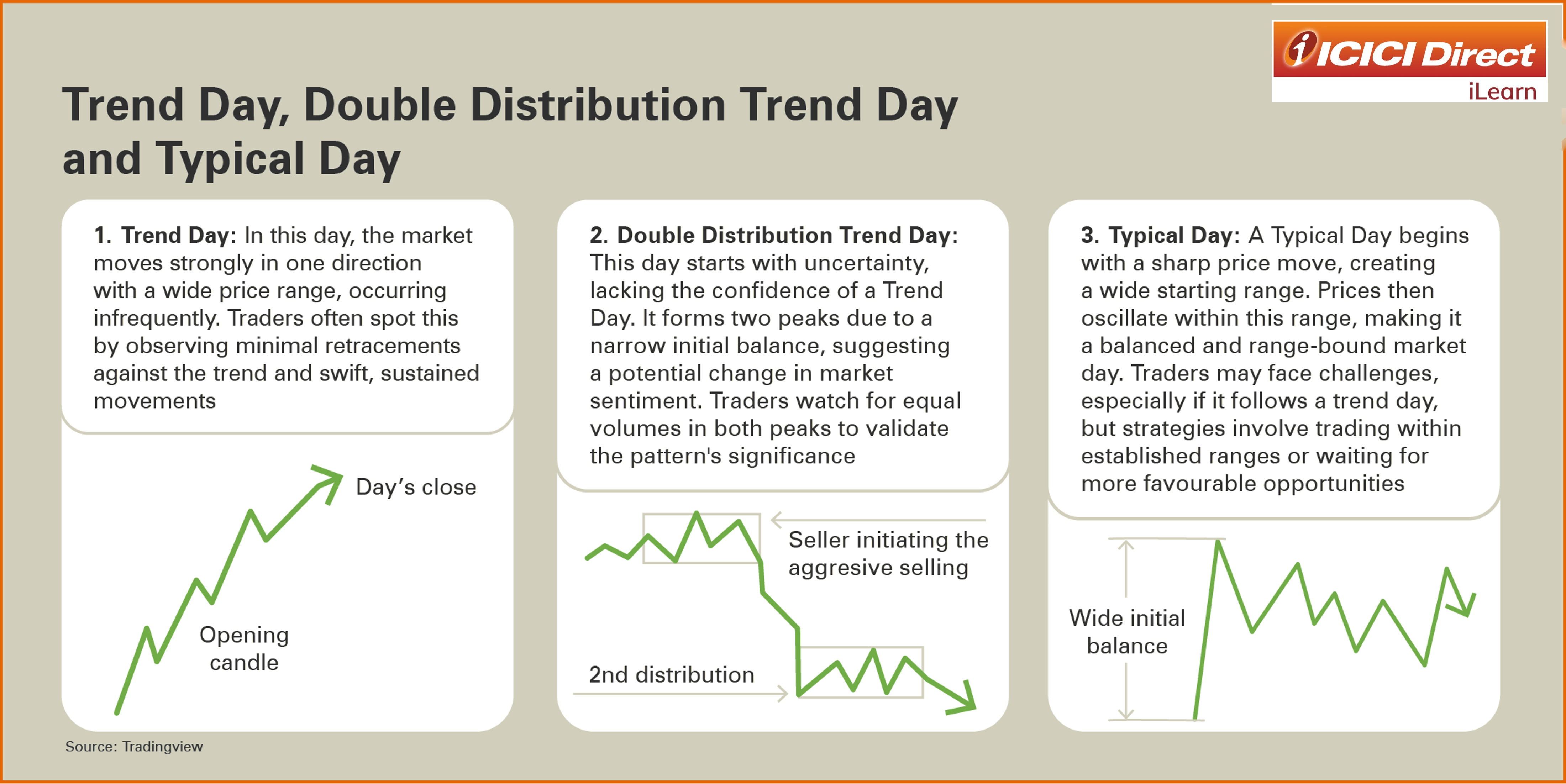
Summary
- Mastering the six types of market days is a helpful tool for anticipating reversals, breakouts, and guiding traders through the constantly changing stock market.
- A Trend Day surges powerfully from the start and sustains a one-directional movement throughout most of the trading session.
- A Double Distribution Trend Day is marked by initial indecision and begins with a quiet market opening, with prices trading in a tight range for the first hour or two. This range sets the initial balance, serving as reference points for trade facilitation.
- A Typical Day in the stock market usually starts with a wide range of prices. After this initial movement, the market usually trades calmly within these high and low points.
In the next chapter we will dive into the remaining market types, enabling you to adjust and make the most of the market's diverse dynamics.






Please Enter Email


 70 Years
 4.4 Star

COMMENT (0)