





Learning Modules Hide
Hide
- Chapter 1: Power of Combined Technical Indicators – Part 1
- Chapter 2: Power of Combined Technical Indicators – Part 2
- Chapter 3: Directional Movement System
- Chapter 4: Rate of Change Indicator (ROC)
- Chapter 5: Comparative Relative Strength Indicator
- Chapter 6: Types of Market Days – Part 1
- Chapter 7: Types of Market Days – Part 2
- Chapter 8: Pivot Points - Part 1
- Chapter 9: Pivot Points – Part 2
- Chapter 10: Value Area Trading – Part 1
- Chapter 11: Value Area Trading – Part 2
- Chapter 1: Introduction to Technical Analysis
- Chapter 2: Introduction to Charts and Chart Types
- Chapter 3: Trends, Support, and Resistances
- Chapter 4: Breakouts, Stops and Reversals
- Chapter 5: Fibonacci Retracements
- Chapter 6: Candlestick Patterns - One and Two Candle Patterns
- Chapter 7: Candlestick Patterns: Three Candle Patterns
- Chapter 8: Chart Patterns
- Chapter 9: Moving Averages and Crossovers
- Chapter 10: Price Volume Confirmation
- Chapter 11: Technical Indicators - Part 1: MACD and Stochastics
- Chapter 12: Technical Indicators - Part 2: Bollinger Bands and Relative Strength Index (RSI)
- Chapter 13: Do’s and Don’ts for Effective Trading Using Technical Analysis

Chapter 1: Power of Combined Technical Indicators – Part 1
In the dynamic realm of trading, individual indicators like RSI, MACD, Stochastic, and Bollinger Bands serve as essential tools. Yet, their true potential lies in the fusion of these indicators, offering traders a nuanced and powerful approach. Think of these tools as different colours in a painting. Alone, they're useful, but when you mix them, they create a beautiful picture. Let's explore how using these tools together can help you make confident moves in the trading world.
Let's recap a few key indicators first:
- RSI (Relative Strength Index): RSI is a momentum oscillator that measures the speed and change of price movements, indicating whether a stock is overbought or oversold. It helps to assess the strength of a trend and potential reversal points.
- Stochastic Oscillator: Another momentum indicator, but it measures the current closing price relative to its price range over a period, identifying overbought or oversold conditions. It helps understand momentum and potential trend reversals. Unlike RSI, Stochastic reacts faster to price changes.
- MACD (Moving Average Convergence Divergence): MACD highlights the relationship between two moving averages, signalling potential changes in trend direction. It offers insight into the momentum and strength of a stock's price movement.
- Bollinger Bands: Bollinger Bands are volatility bands placed above and below a moving average that dynamically adjust based on market volatility. They visualize price volatility, potential overbought or oversold conditions, and potential trend reversals.
Essentially, each indicator has its unique way of looking at the market. RSI measures momentum, Stochastic gauges current price compared to its range, MACD watches trend strength, and Bollinger Bands help visualize volatility.
Now, let's delve deeper into how we can mix these indicators to create robust trading strategies.
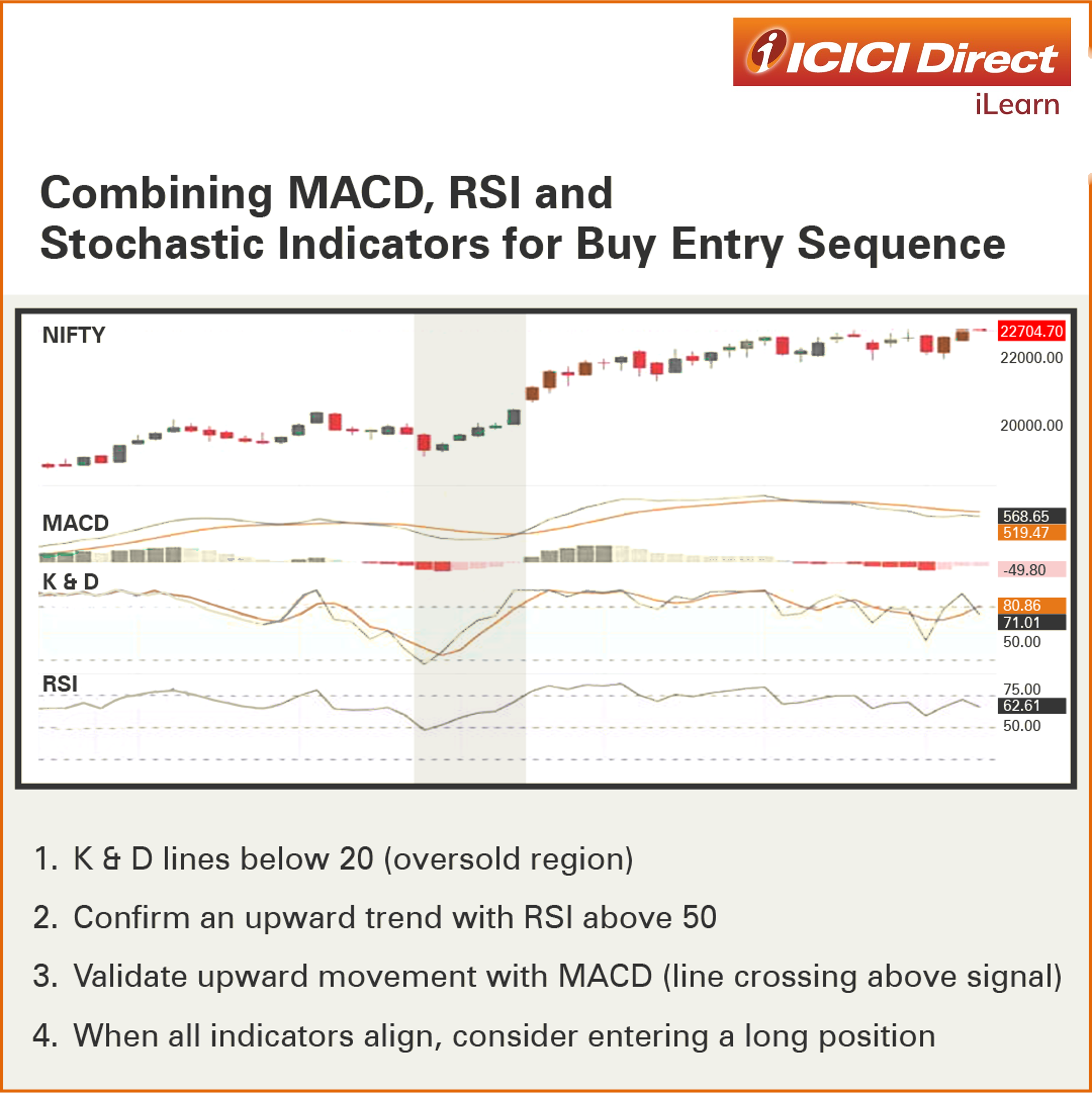
Combination 1: Combining MACD, RSI and Stochastic Indicators
Each of these indicators focuses on momentum and price action but does so in slightly different ways. The strategy functions as a trend-following approach and uses Stochastic for trade entry, supported by RSI and MACD histogram as confirmation signals. The idea is that in a volatile market, riskier trades may yield higher rewards compared to safer ones.
- Stochastics’ Role: This indicator, with its 'oversold' and 'overbought' signals, serves as an entry point when coupled with other indicators. It may yield lower success rates when used independently but adds value when combined.
- RSI's Confirmation: RSI not only indicates strength or weakness but also validates trends when employed alongside other indicators. One common application of the RSI is trading in the oversold and overbought areas. However, we already have the stochastic for that. So, in this strategy the RSI is used for trend confirmation. By modifying RSI settings to a single line at the 50 level, it becomes a centre line, serving as both support and resistance. An RSI above 50 typically signifies strength, while readings below 50 indicate weakness. RSI's ability to visualize divergences between price movements and the indicator enhances its effectiveness in decision-making, as noted by J Wells Wilder, the father of RSI, who observed that chart formations and key levels are often clearer on the RSI chart than on the price chart.
- MACD's Validation: Traditionally used for buying and selling signals, in this strategy, MACD confirms market momentum before executing trades.
Read More: Learn MACD and Stochastics Technical Indicators in Detail
Let's break down the application of these indicators into actionable steps:
Buy Entry Sequence:
- Check for oversold regions on Stochastic. (both K & D lines should be below 20)
- Confirm an upward trend with RSI above 50.
- Validate upward movement with MACD. (The MACD line should cross above the signal line)
- Once all indicators align, consider entering a long position.
Sell Entry Sequence:
- Identify overbought regions on Stochastic. (both K & D lines should be above 80)
- Confirm a downward trend with RSI below 50.
- Validate downward movement with MACD. (The MACD line should cross below the signal line)
- If all indicators align, consider initiating a short position.
Stop Loss Placement:
Near nearest swing high for short positions, nearest swing low for long positions.
Incorporating volume analysis alongside these indicators enriches your strategy, offering a more comprehensive view of potential trade setups and reducing the likelihood of false signals.
Remember, it's not just about comprehending these indicators; it's about practicing their application. So, lets understand the strategy using an example of a sell-side strategy:
We have backtested this strategy on the daily timeframe of Adani enterprises. The first step is to look at the stochastic indicator. In the chart below, the stochastic lines K & D are in the overbought region, this indicates that the stock has reached an area where it will likely to move downwards. Then, we leverage RSI and MACD for a downtrend confirmation. The MACD line is crossing below the signal line, the RSI is below 50, and the price has broken through a significant support level. These signals indicate that a downtrend is likely to be confirmed.
We can enter a short trade when all three criteria are met, seeking additional confirmation from bullish patterns or candlesticks (like we confirmed using a simple support level). You may consider a lower timeframe for confirmation. Remember to place your stop loss above the nearest swing high.

|
Did You know? J. Welles Wilder Jr. introduced RSI, PSAR, ATR, and ADX in his 1978 book "New Concepts in Technical Trading Systems". Surprisingly, despite predating computers, these indicators continue to remain highly popular and effective in modern trading strategies, with RSI being preferred by almost 1 in every 2 traders worldwide. |

Advanced Mean Reversion
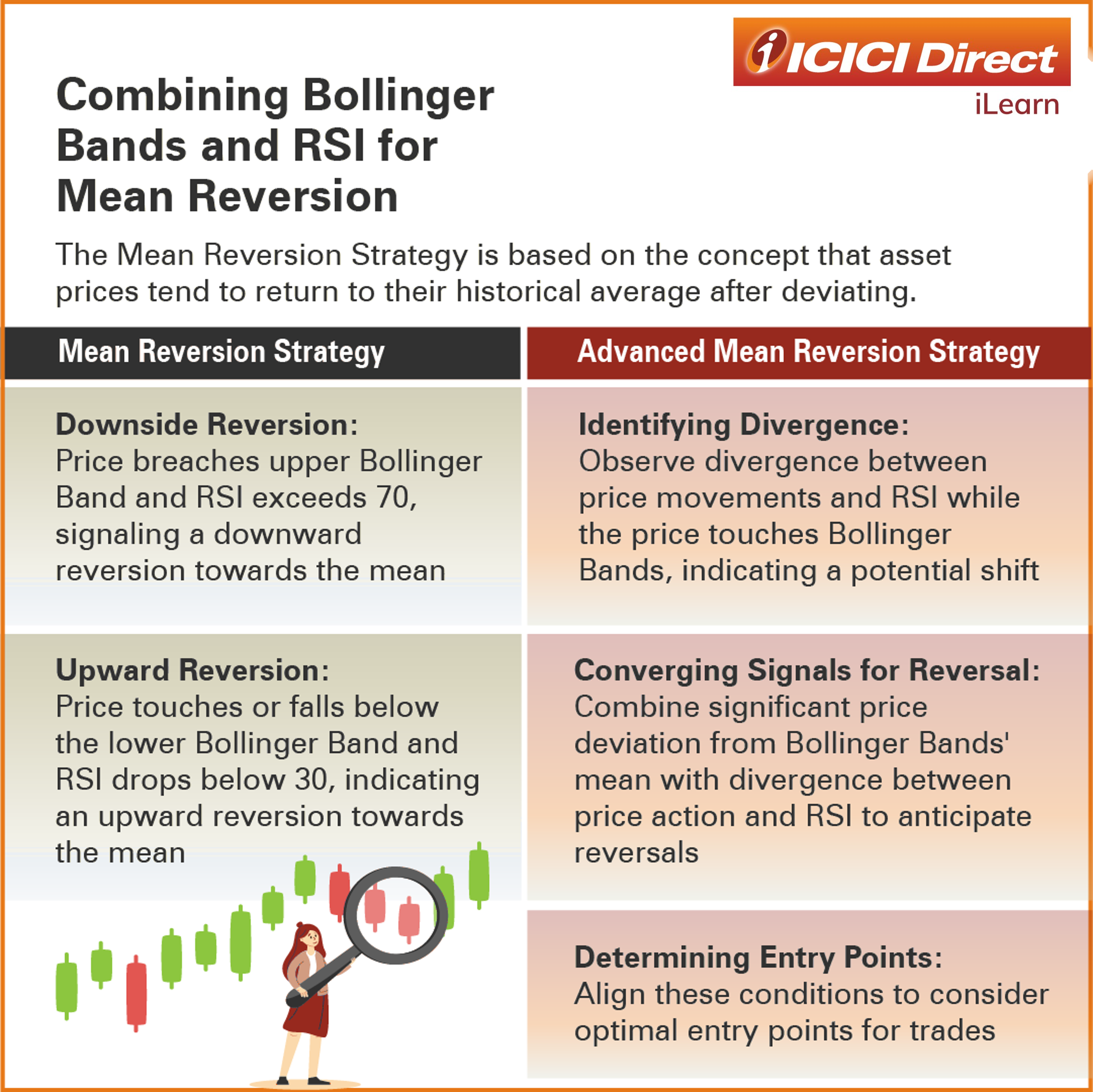
The Advanced Mean Reversion with Divergence strategy elevates Mean Reversion approach by integrating divergence analysis to identify potential reversals.
To capitalize on this, traders await a confluence of signals:
- Look for Divergence: Search for divergence between the price movement and RSI while the price touches or breaches the upper or lower Bollinger Bands. For example, if the price makes new highs (or lows) but RSI fails to confirm these highs (or lows) by forming lower (or higher) highs, it indicates divergence.
- Combine Signals for Potential Reversal: When the price deviates significantly from the mean (as per Bollinger Bands) and there's divergence between the price action and RSI, it suggests a potential reversal. This confluence indicates a higher probability of the price reverting towards the mean and possibly reversing its direction.
- Entry point: Once these conditions converge, indicating a possible reversion towards the mean, traders consider entry points to initiate a trade.
Summary
- Combining RSI, MACD, Stochastic, and Bollinger Bands crafts potent trading strategies, akin to tools in a kit, facilitating precise market navigation.
- Strategies like Mean Reversion and Advanced Mean Reversion with Divergence, incorporating Bollinger Bands and RSI, identify potential market reversals.
- Integration of volume analysis enhances strategy reliability by reducing false signals.






Please Enter Email


 70 Years
 4.4 Star

COMMENT (0)