





Learning Modules Hide
Hide
- Chapter 1: Power of Combined Technical Indicators – Part 1
- Chapter 2: Power of Combined Technical Indicators – Part 2
- Chapter 3: Directional Movement System
- Chapter 4: Rate of Change Indicator (ROC)
- Chapter 5: Comparative Relative Strength Indicator
- Chapter 6: Types of Market Days – Part 1
- Chapter 7: Types of Market Days – Part 2
- Chapter 8: Pivot Points - Part 1
- Chapter 9: Pivot Points – Part 2
- Chapter 10: Value Area Trading – Part 1
- Chapter 11: Value Area Trading – Part 2
- Chapter 1: Introduction to Technical Analysis
- Chapter 2: Introduction to Charts and Chart Types
- Chapter 3: Trends, Support, and Resistances
- Chapter 4: Breakouts, Stops and Reversals
- Chapter 5: Fibonacci Retracements
- Chapter 6: Candlestick Patterns - One and Two Candle Patterns
- Chapter 7: Candlestick Patterns: Three Candle Patterns
- Chapter 8: Chart Patterns
- Chapter 9: Moving Averages and Crossovers
- Chapter 10: Price Volume Confirmation
- Chapter 11: Technical Indicators - Part 1: MACD and Stochastics
- Chapter 12: Technical Indicators - Part 2: Bollinger Bands and Relative Strength Index (RSI)
- Chapter 13: Do’s and Don’ts for Effective Trading Using Technical Analysis

Chapter 8: Pivot Points - Part 1
Pivot points are a technical analysis indicator commonly used in trading to determine potential support and resistance levels for a given time frame. The chapter tries to explain how pivot points are calculated, their different types, and how traders use them to make informed decisions on entry, exit, and trend confirmation.
Imagine you're hiking up a mountain. The pivot point is like your starting point – it helps you know where you are. Along the way, you find rocks below (support) and gusts of wind above (resistance). These represent levels where the price might stop or reverse. Traders use these points to decide when to buy or sell stocks. If you're climbing and hit a support level, it's like finding a solid step to rest on. If you reach a resistance level, it's like hitting a strong wind that might push you back. So, pivot points are like markers on your journey, helping you make decisions about which path to take in the trading world.
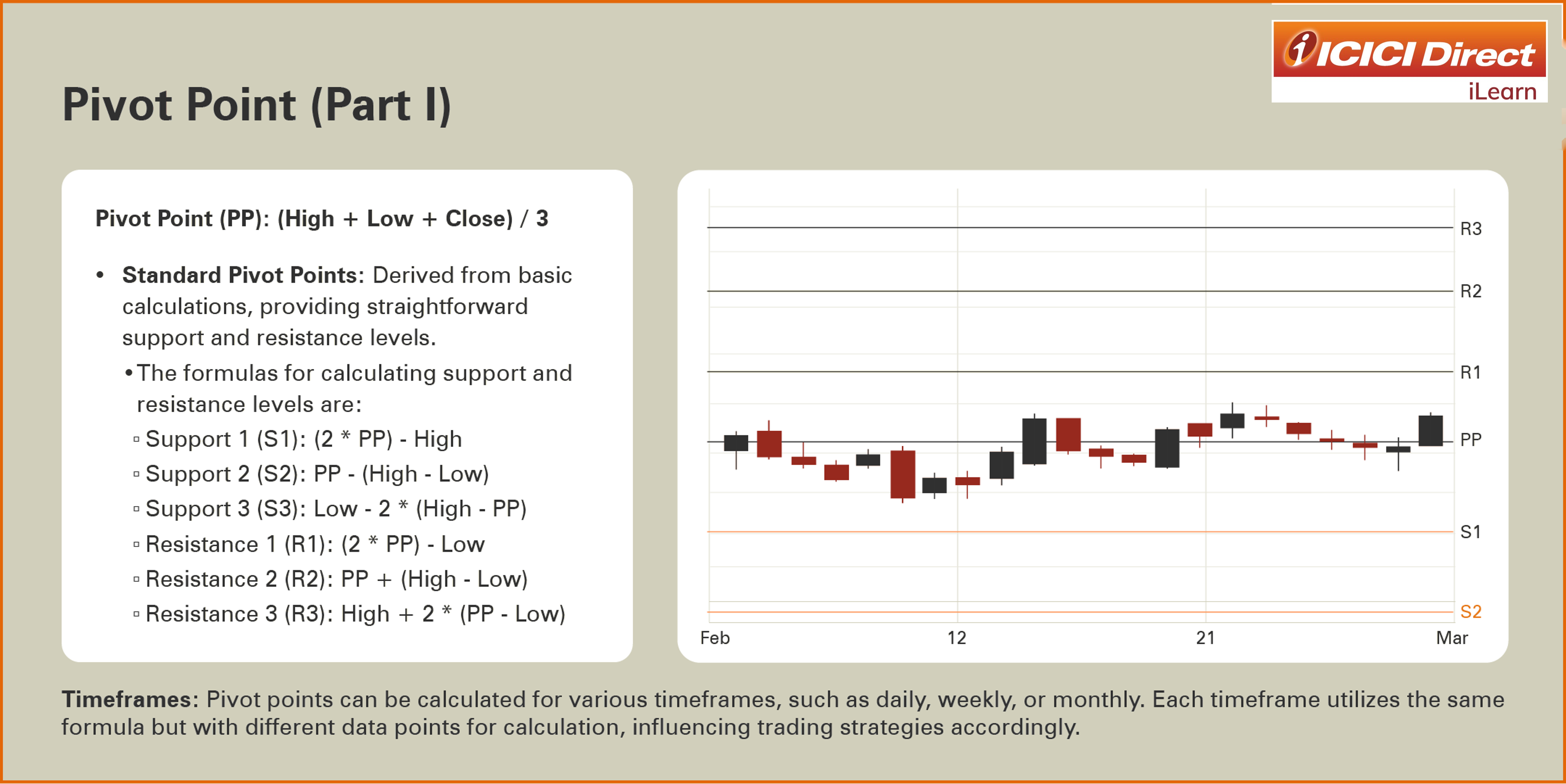
Pivot Points are calculated based on the previous period's high, low, and close prices. They are the average of the previous period's high, low, and close.
The calculation typically involves:
- Pivot Point (PP): Calculated as (High + Low + Close) / 3
- Support Levels (S1, S2, S3): These are potential price levels below the pivot point where a stock might find support if it is moving downwards.
- Resistance Levels (R1, R2, R3): These are potential price levels above the pivot point where a stock might encounter resistance if it is moving upwards.
The common formulas for calculating support and resistance levels are:
- Support 1 (S1): (2 * PP) - High
- Support 2 (S2): PP - (High - Low)
- Support 3 (S3): Low - 2 * (High - PP)
- Resistance 1 (R1): (2 * PP) - Low
- Resistance 2 (R2): PP + (High - Low)
- Resistance 3 (R3): High + 2 * (PP - Low)
Traders use pivot points to identify potential turning points in the market. When the price is above the pivot point, it's considered bullish, and traders may look for buying opportunities. Conversely, when the price is below the pivot point, it's considered bearish, and traders may look for selling opportunities. Additionally, traders may use pivot points to set stop-loss orders or to determine profit targets.
Calculation basis different timeframes
Pivot points can be calculated for different timeframes, such as daily, weekly, or even intraday periods. The calculation method remains the same, but the data used for the calculation varies based on the chosen timeframe. Once Pivot Points are set, they do not change and remain in play throughout the day.
Here's a general overview of how pivot points are calculated for different timeframes:
- Daily Pivot Points: For daily pivot points, you use the high, low, and close prices of the previous trading day to calculate the pivot point and support/resistance levels for the current trading day. This can be done for various intraday timeframes, such as 1-minute, 5-minute, 10-minute or 15-minute intervals.
- Weekly Pivot Points: Weekly pivot points are calculated similarly to daily ones, but you use the high, low, and close prices of the previous week to calculate the pivot point and support/resistance levels for the current week. This can be done for 30-minute, 60-minute and 120-minute charts. The Pivots do not change until the weekends and new ones can be calculated.
- Monthly Pivot Points: Monthly Pivot Points utilize the previous month's high, low, and close prices to compute pivot points and support/resistance levels for the ongoing trading session. This can be applied to daily charts and remain constant throughout the month. For example, Pivot Points for April 1st are derived from the March’s high, low, and close prices. These levels remain constant throughout April, with new calculations initiated on May's first trading day.
|
Did you know? A fascinating aspect of pivot points is their historical significance. They were initially developed by floor traders in the early 20th century to navigate the complexities of trading floors. Pivot points were initially devised for floor traders in futures markets. Calculated manually using the previous day's price data, they anticipated support and resistance levels. |
Types of Pivot Points
There are at least five different versions of Pivot Points, namely Standard pivot points, Fibonacci pivot points, Woodie’s pivot points, Camarilla pivot points and DeMark pivot points. However, in this chapter, we will focus on Standard Pivot Points, and Fibonacci Pivot Points.
Ultimately, the choice of which type of pivot point to use depends on your trading style, preferences, and the effectiveness of the pivot points in the specific market conditions you're analysing. It may be beneficial to experiment with different types and observe how they align with your trading objectives before settling on a preferred approach.
Understanding Standard Pivot Points
Standard pivot points are one of the most commonly used types of pivot points in trading. These points offer traders essential levels indicating potential support and resistance derived from the prior period's high, low, and close prices. Here's a detailed explanation of standard pivot points:
Calculation
1. Pivot Point (PP): The pivot point is calculated by adding together the previous period's high, low, and close prices, and then dividing the sum by 3.
- Pivot Point (PP) = (High + Low + Close) / 3
2. Support and Resistance Levels:
- Support 1 (S1): This level is derived by subtracting the previous period's high price from twice the pivot point.
- Support 1 (S1) = (2 * PP) - High
- Resistance 1 (R1): This level is derived by subtracting the previous period's low price from twice the pivot point.
- Resistance 1 (R1) = (2 * PP) - Low
Interpretation
- Central Pivot Point (PP): Market sentiment may be interpreted based on the position of the current price relative to the pivot point. A price above the pivot point could signal bullish sentiment, whereas a price below it might suggest bearish sentiment.
- Support and Resistance Levels:
- Support 1 (S1): This is the first level of potential support below the pivot point. If the price declines and reaches this level, it may find some buying interest.
- Resistance 1 (R1): This is the first level of potential resistance above the pivot point. If the price rises and reaches this level, it may encounter selling pressure.

The chart above is of Axis Bank with Standard Pivot points on a 15-minute chart. At the start of trading on 22nd March, the Pivots are calculated based on the previous day’s (21st March) high, low and close (highlighted in the yellow box). You can see that the Pivot Point(P) is in the middle, the resistance levels (R1 & R2) are above and the support levels (S1 & S2) are below P. These levels are consistent throughout the trading day.
Usage
- Trading Signals: Traders often use standard pivot points to identify potential entry and exit points. For instance, a rebound from a support level could indicate a buy signal, while a failure to breach a resistance level might suggest a selling opportunity.
- Stop Loss and Take Profit Levels: Traders may also use pivot points to set stop-loss orders below support levels and take-profit orders near resistance levels to manage risk and lock in profits.
Standard pivot points provide traders with a simple yet effective framework for analysing price movements and making trading decisions based on key support and resistance levels derived from the previous period's price action.
Fibonacci Pivot Points
Fibonacci Pivot Points are a variation of traditional pivot points that incorporate Fibonacci retracement levels into their calculation. They are based on Fibonacci ratios, such as 0.382, 0.618, etc., which are applied to the range between the high and low prices of the previous period. They provide traders with additional levels of potential support and resistance, which are based on key Fibonacci ratios. Here's a detailed explanation of Fibonacci Pivot Points:
Calculation
- Pivot Point (PP): The pivot point is calculated the same way as standard pivot points.
- Pivot Point (PP) = (High + Low + Close) / 3
- Support and Resistance Levels:
- Support 1 (S1): This level is calculated by subtracting the difference between the high and low prices from the pivot point, multiplied by a Fibonacci ratio. The common ratio used is 0.382.
- Support 1 (S1) = PP - (High - Low) * 0.382
- Resistance 1 (R1): This level is calculated by adding the difference between the high and low prices to the pivot point, multiplied by the same Fibonacci ratio used for the support level.
- Resistance 1 (R1) = PP + (High - Low) * 0.382
Interpretation
- Pivot Point (PP): As with standard pivot points, the pivot point serves as a reference level. A price above the pivot point may suggest bullish sentiment, while a price below it may indicate bearish sentiment.
- Support and Resistance Levels:
- Support 1 (S1): This level represents the first level of potential support below the pivot point, based on the Fibonacci ratio. Traders may expect some buying interest if the price approaches this level.
- Resistance 1 (R1): This level represents the first level of potential resistance above the pivot point, based on the same Fibonacci ratio. Traders may anticipate selling pressure if the price approaches this level.

The chart above shows Adani Enterprises with Fibonacci Pivot Points on an hourly chart. R1 and S1 are based on the 38.2% level, while R2 and S2 are based on the 61.8% level. As you can see, the stock consolidated between the initial R1 and S1 (38.2% Fibonacci levels) before breaking through the S1 and S2 levels (38.2% and 61.8% Fibonacci levels) with a significant gap down. A gap down with high volume is a strong indicator that the next support level will also be breached. Therefore, considering these signals, a prudent trader would know to exit at S2 (61.8% Fibonacci level).
Usage
- Trading Signals: Fibonacci Pivot Points can be used similarly to standard pivot points to identify potential entry and exit points. Traders may look for reversals or breakouts at these Fibonacci-derived levels.
- Trend Confirmation: Traders may also use Fibonacci Pivot Points to confirm the direction of the trend. For example, if the price bounces off a Fibonacci support level during an uptrend, it may signal a continuation of the trend.
- Combination with Other Indicators: Traders often combine Fibonacci Pivot Points with other technical indicators or chart patterns to enhance their trading decisions.
Fibonacci Pivot Points provide traders with additional levels of potential support and resistance derived from Fibonacci retracement levels. By incorporating these levels into their analysis, traders may gain further insight into price movements and potential trading opportunities.

Summary
- Pivot points provide a roadmap for anticipating price movements by using the previous period's high, low, and close prices.
- They are effective across different timeframes, with adjustments made accordingly.
- Standard Pivot Points offer simplicity, while Fibonacci Pivot Points add depth with Fibonacci ratios.
- Traders use pivot points to identify entry and exit points, set stop-loss and take-profit levels, and confirm trends.
- Pivot points are often combined with other indicators for comprehensive analysis.
In the next chapter we will understand in detail about different strategies that we use using Standard and Fibonacci pivot points.






Please Enter Email


 70 Years
 4.4 Star

COMMENT (0)