





Learning Modules Hide
Hide
- Chapter 1: Power of Combined Technical Indicators – Part 1
- Chapter 2: Power of Combined Technical Indicators – Part 2
- Chapter 3: Directional Movement System
- Chapter 4: Rate of Change Indicator (ROC)
- Chapter 5: Comparative Relative Strength Indicator
- Chapter 6: Types of Market Days – Part 1
- Chapter 7: Types of Market Days – Part 2
- Chapter 8: Pivot Points - Part 1
- Chapter 9: Pivot Points – Part 2
- Chapter 10: Value Area Trading – Part 1
- Chapter 11: Value Area Trading – Part 2
- Chapter 1: Introduction to Technical Analysis
- Chapter 2: Introduction to Charts and Chart Types
- Chapter 3: Trends, Support, and Resistances
- Chapter 4: Breakouts, Stops and Reversals
- Chapter 5: Fibonacci Retracements
- Chapter 6: Candlestick Patterns - One and Two Candle Patterns
- Chapter 7: Candlestick Patterns: Three Candle Patterns
- Chapter 8: Chart Patterns
- Chapter 9: Moving Averages and Crossovers
- Chapter 10: Price Volume Confirmation
- Chapter 11: Technical Indicators - Part 1: MACD and Stochastics
- Chapter 12: Technical Indicators - Part 2: Bollinger Bands and Relative Strength Index (RSI)
- Chapter 13: Do’s and Don’ts for Effective Trading Using Technical Analysis

Chapter 2: Power of Combined Technical Indicators – Part 2
In the previous chapter, we geeked out over RSI, Stochastic, Bollinger Bands, and MACD combination strategies. Now, let's take it up a notch! We're diving into the deep end of advanced indicators, mixing and matching them with the popular indicators like MACD, EMA, and SMA. These strategies cater especially to intraday and short-term traders, although long-term traders and investors can also benefit from their utility in short-term trades.
Strategy 1: Combining VWAP & Moving Average
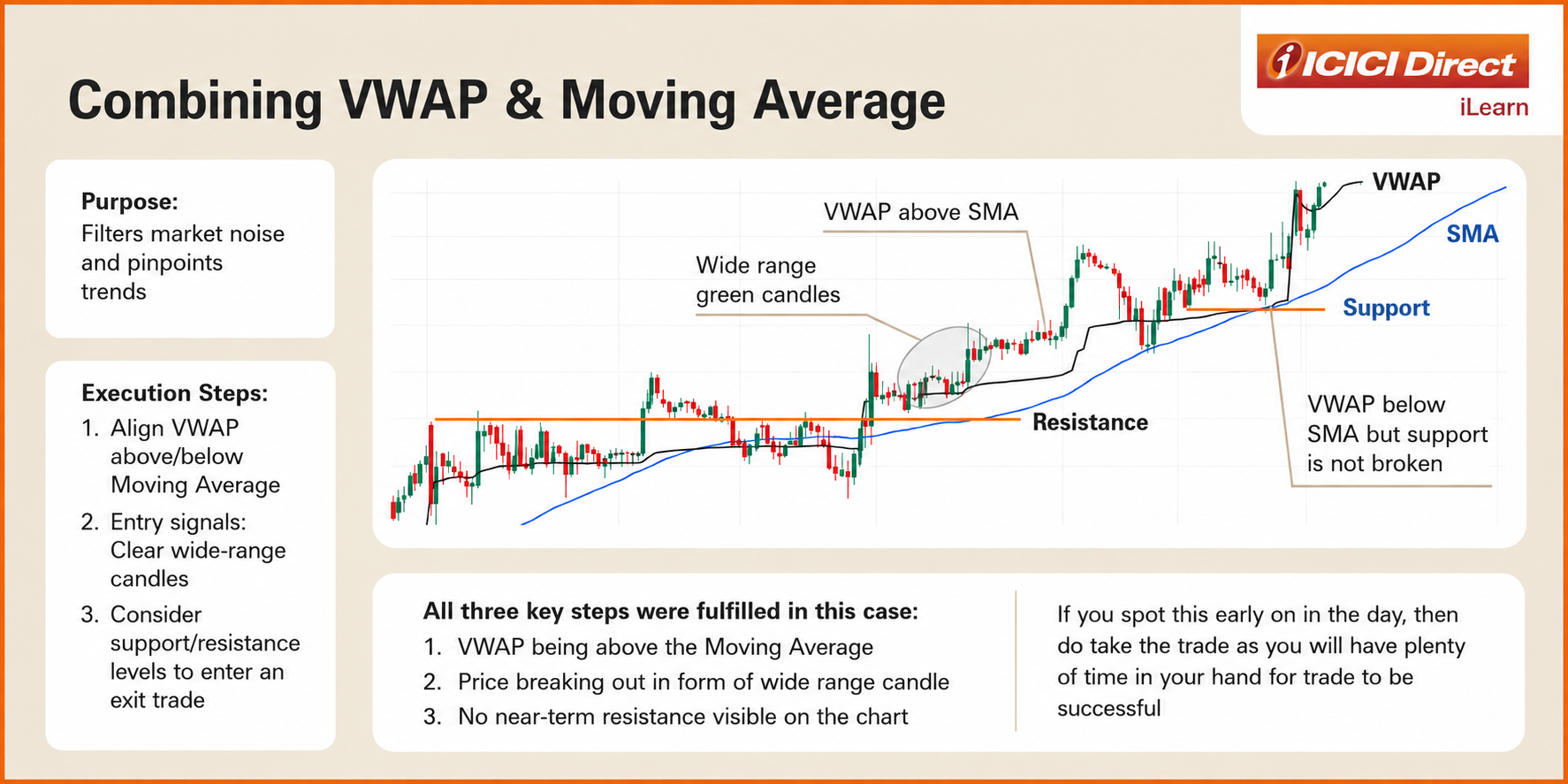
This approach combines the VWAP Indicator and a 50-period Simple Moving Average (SMA), forming the VWAP-Moving Average strategy. This strategy provides a framework for traders seeking to navigate the intraday market dynamics.
The combination of VWAP and the Moving Average aims to filter market noise and identify trend directions. The crux lies in going long when VWAP is above the Moving Average and short sell when the VWAP falls below the Moving Average.
Understanding VWAP
VWAP stands for Volume Weighted Average Price, used to measure the average price of a security throughout the trading day, based on both volume and price. Unlike a simple average price, VWAP takes into account the trading volume at each price level. This means that prices with higher trading volume carry more weight in the calculation. Traders utilize VWAP to discern trends and potential support/resistance levels. When using VWAP in trading strategies, a common rule is to prefer long trades when the current price is above VWAP and short sell trades when the price is below VWAP, aiming to align trades with the prevailing market sentiment. The formula to calculate VWAP is as follows:
VWAP = Cumulative (Typical Price x Volume) / Cumulative (Volume)
Let's say we have the following trades for a stock during a trading session:
Trade 1: 100 shares at ₹150 each
Trade 2: 200 shares at ₹155 each
Trade 3: 150 shares at ₹152 each
To calculate VWAP, we first multiply the price of each trade by the volume of shares traded at that price, then sum up these products, and finally divide by the total volume traded.
Using the formula:
VWAP =
VWAP =
VWAP =
VWAP = 152.89
So, the VWAP for this trading session would be approximately ₹152.89.
To effectively execute this strategy
- Ensure VWAP is above/below the Moving Average for long/short trades.
- Identify clear wide range candles as entry signals.
- Validate price positions concerning near-term support/resistance levels.
- Check for volume expansion in the direction of the trade.
- Comprehend price cycles in stocks, pivotal for situational awareness and success in intraday trading. Understanding price cycles in stocks is crucial to limit whipsaws and boost average profits per trade. High beta stocks typically follow systematic up and down price movements. Intraday traders benefit from recognizing these cycles. For instance, during downward price movements, short sell trades align well with VWAP below the Moving Average. Conversely, in upward movements, prefer long trades with VWAP above the Moving Average.
- Avoid random implementation of VWAP Indicator and Moving Average – identify paths of least resistance for entry.
Let’s understand using an example.

Let's practice this strategy on a 5-minute Axis Bank chart. We have taken a 50-period Simple Moving Average and the default settings of VWAP in this example.
The first thing is to check whether the VWAP is above the 50 SMA line. In the chart above you can clearly see that the even though the VWAP is above the moving average, there is a strong resistance which the price is unable to break. Therefore, the trade cannot be taken here. Over the next few minutes, as price consolidates and then breaks the resistance, the VWAP also moves above the moving average at this point. All three key steps were fulfilled in this case, with VWAP being above the Moving Average, price breaking out in form of wide range candle and no near-term resistance visible on the chart. If you spot this early on in the day, then do take the trade as you will have plenty of time in your hand for trade to be successful.
Read More: VWAP: UNVEILING THE POWER OF VOLUME WEIGHTED AVERAGE PRICE FOR TRADERS
Conclusion
- The strategy's adaptability across different timeframes becomes pivotal for intraday traders. While five-minute charts serve short setups well, ten-minute charts might offer a more conducive environment for long setups, aiding in refining intraday trade executions.
- There are two specific instances where you should avoid using this strategy.
- The first instance is when you spot a gap up or gap down, as such gap movements distort the chart for the day. When a gap occurs on the chart, VWAP Indicator adjusts right away, but moving average, being a lagging indicator, takes some more time to adjust. This makes it difficult to trade the chart, as one of the key elements does not reflect data accurately.
- Second instance to avoid is when you see price moving with extreme short-term momentum. For instance, if the VWAP Indicator is below the Moving Average but the price climbs higher than, say, 2%, this indicates that there is a significant price deviation from the indicators, which may cause the Risk Reward to work against you. As a result, let the trade pass and watch for the price to return to the VWAP Indicator.
Strategy 2: Combining MACD, EMA & Parabolic SAR
After learning about an effective intraday strategy, let’s move to a strategy which works better in short term trades. This strategy harnesses the collective strengths of the popular MACD, and 200 EMA indicators along with Parabolic SAR to identify optimal entry and exit points, maximizing the potential for successful trades.
Understanding Parabolic SAR
Parabolic Stop and Reverse (PSAR) is primarily used to identify potential reversal points in the price direction of a stock. PSAR is represented by a series of dots that appear either above or below the price/ candlesticks. These dots move dynamically based on price action efficiently identifying market trends. When the dots are below the price/candle, they act as support levels and signals an uptrend, and when they’re above the price, they serve as resistance levels-indicating a downtrend. When the dots switch sides, it suggests a potential change in trend direction.

Source: https://scanz.com/comprehensive-guide-psar/
Additionally, PSAR works best in trending markets and may generate false signals in choppy or ranging conditions. Therefore, here, we employ it for trend confirmation rather than direct trading decisions.
Implementing the Strategy
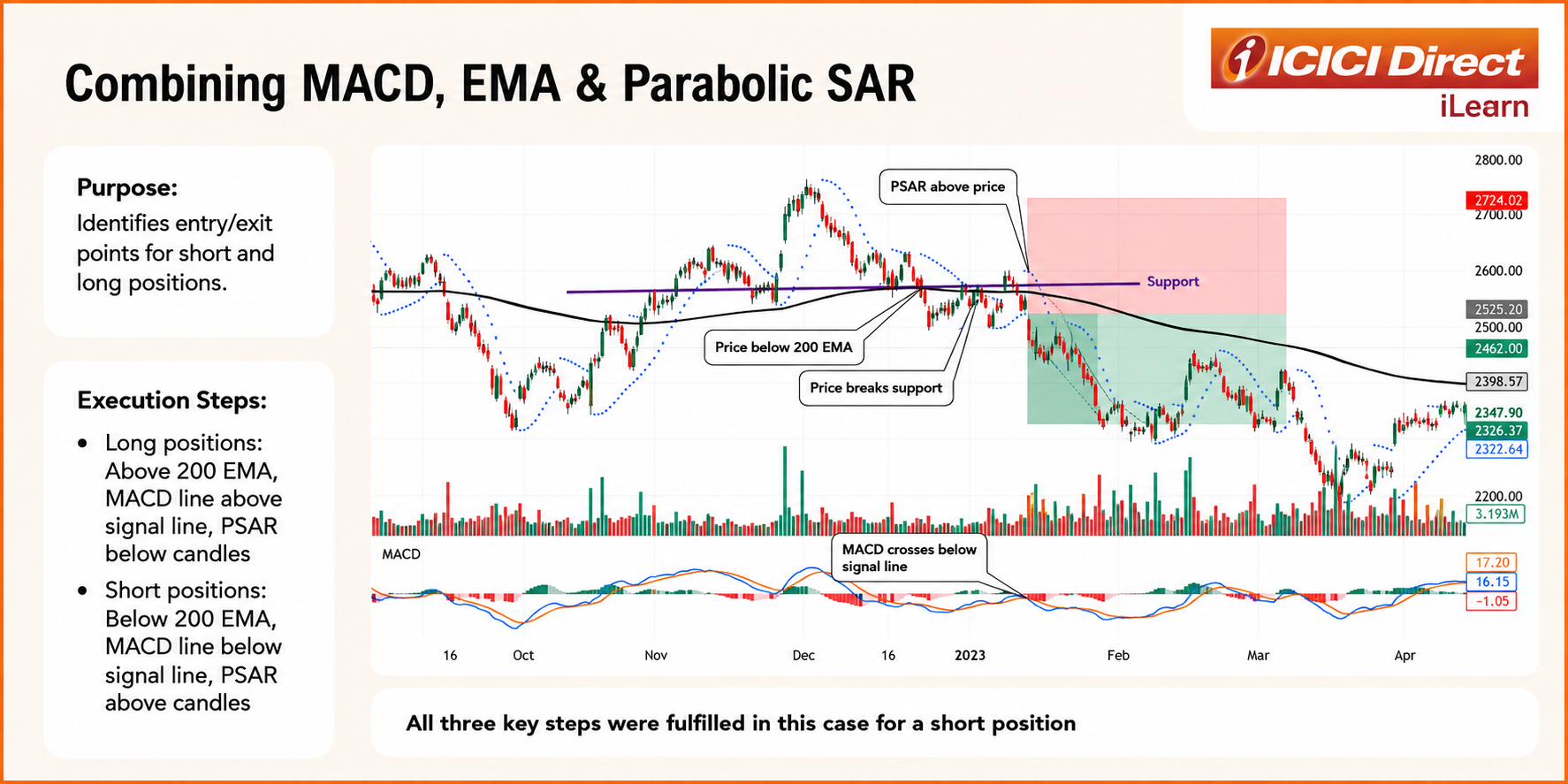
For long positions:
- Price should be above the 200 EMA
- MACD line crosses above the signal line
- Parabolic SAR dots should be below the candlesticks
- Entry points entail careful alignment of these indicators.
- Exit strategy involves setting stop-loss at the Parabolic SAR and a profit target at a 1:1 risk ratio.
For short positions:
- Price should be below the 200 EMA
- MACD line crosses below the signal line
- Parabolic SAR dots should be above the candle
- Entry points entail careful alignment of these indicators.
- Exit strategy involves setting stop-loss at the Parabolic SAR and a profit target at a 1:1 risk ratio.
Understanding through examples

We will be back testing the short strategy on a 4-hour chart of Reliance Industries.
We have taken 200 EMA, MACD at default settings and PSAR indicator at default settings in this example.
The first step is to check whether the price is below the 200 EMA and the MACD line is crossing below the signal line, while the PSAR dots are positioned above the candlesticks. If these conditions are met along with the price breaking a strong support, then this will act as a confirmation to enter a short position. As you can see on the chart the price has broken a strong support with good volume and has met all 3 conditions mentioned above. Therefore, we have entered a short position here, and have placed my stop loss where the highest PSAR is with a profit target of 1.1 (Risk: Reward ratio is 1:1). As you can see the profit target comes at the next swing low.
However, there could be a chance when the price is below 200 EMA and the MACD crosses the signal line from above, but the PSAR dots are not above the price. So, in situations like this we wait for the PSAR to go above the price while making sure that the MACD is still crossing downwards, to enter a short position.
Fine-tuning the strategy
To further refine this strategy, consider tweaking parameters and conducting personalized backtests. Additionally, managing stop-loss limits and exploring diverse risk levels can optimize outcomes. Notably, limiting stop-loss to 0.7 mitigates risk but may cap potential gains.
|
Did you know? Alexander Elder, a renowned trader, frequently leverages the Parabolic SAR indicator in his comprehensive trading strategies. His work, including "Trading for a Living," underscores the PSAR's role in spotting trends and guiding market entries/exits. |
Summary
- Strategy 1 blends VWAP and Moving Average to spot trends, focusing on clear alignment for better trades.
- Strategy 2 combines MACD, 200 EMA, and Parabolic SAR, offering detailed entry and exit points.
- Being aware of specific market instances is crucial. Instances like gap movements or extreme short-term momentum require caution and might not align well with these strategies.
- Constantly refine these strategies by tweaking parameters and conducting personalized backtests. Remember, being adaptable across different timeframes and staying alert in the market are crucial. This helps tailor the strategies to your trading style and preferences.
In the following chapter, we'll explore the Directional Movement System, encompassing tools such as the Directional Movement Index (DMI) and the Average Directional Index (ADX), and how to utilize them for gauging trend strength and direction.






Please Enter Email


 70 Years
 4.4 Star

COMMENT (0)