






Download
iLearn application
Elevate Your Financial Knowledge with the
ICICI Direct iLearn App




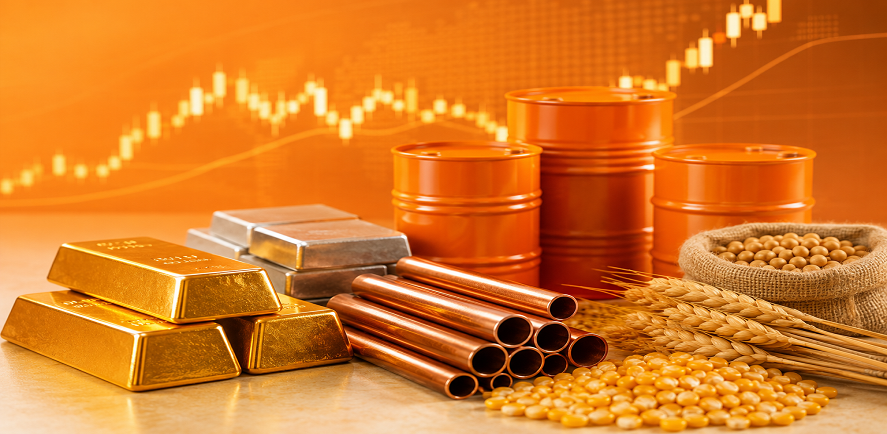
Gold can react to inflation data, while crude oil may jump after an inventory report or geopolitical disruption. This close link between real-world events and prices makes commodities fast-moving. Retail traders in India usually participate through regulated derivative contracts, not by storing metal or fuel. Understanding exchanges, contracts, margins, timings and settlement make the market easier to approach with a plan.
Commodity trading means buying or selling contracts linked to raw materials such as gold, silver, crude oil, natural gas, copper and others. Retail traders generally use futures and options instead of handling physical goods. Prices respond to demand, supply, currency movement, weather, policy decisions, economic data and global events, so each trade needs a clear risk limit.
The market may move quickly, but getting started should not. Work through these steps before placing the first order.
Open a trading account with a SEBI-registered broker that provides commodity access. Opening a trading account is only the first step. Commodity access does not become active automatically, so the segment must be enabled separately.
You will usually need:
India currently has four national exchanges that offer commodity derivatives trading.
MCX dominates bullion, energy, and base metals trading.
NCDEX is the leading agricultural commodity exchange.
NSE and BSE have commodity segments, but trading volumes are much smaller than MCX.
Begin with one liquid commodity. Watch how it reacts to market news and read the contract specifications before trading.
Commodity Futures: An agreement to buy or sell at a predetermined price on a future date. Requires a margin deposit.
Commodity Options: An options contract gives the buyer the right, but not the obligation, to buy or sell an asset.
Call Option: Gives the buyer the right to buy a specific quantity of a commodity at a fixed price before or on a set expiry date.
Put Option: Gives the buyer the right to sell a specific quantity of a commodity at a fixed price before or on a set expiry date.
To get this right, the buyer pays an amount called the option premium to the seller.
The seller receives the premium and is required to maintain the applicable margin and is obligated to fulfil the contract if the buyer chooses to exercise it.
In short:
Buyer = Right, no obligation, Seller = Obligation, no right.
You cannot enter a commodity trade with any quantity you choose. Commodities are traded in specific units called "lots." A variant refers to the contract's scale. Exchanges often provide multiple contract variants to accommodate different capital requirements. For instance, while a standard “Gold” contract is for 1 kg, a "Gold Mini" variant allows trading in smaller denominations, i.e. 100 g, making it more accessible for retail investors with lower capital requirements.
Additional Read: Commodity Variants of Futures & Options
Non-agricultural contracts trade for longer because global cues continue after the equity market closes. Gold, silver, crude oil, natural gas and base metals on MCX generally trade from 9:00 AM to 11:30 PM or 11:55 PM, depending on the daylight-saving calendar. Check the live exchange schedule before trading.
Additional Read: MCX Trading Hours Revised from March 9, 2026 Due to US DST
Margin makes a large trade accessible with less upfront capital. The same feature, however, can make losses grow faster when prices move against you. For example, if a crude oil contract is worth ₹10 lakh and the margin is 12%, about ₹1.2 lakh is blocked. Actual requirements change with price, volatility and exchange.
Before entering a trade, check:
Do not use the full available margin just because it is available. Keep spare funds, as sudden price moves can trigger margin shortfalls. A fast-moving market may look attractive, but speed alone is not a reason to enter a trade.
Break-even is the price your trade must reach just to recover its costs. Until that level is crossed, the trade isn’t profitable.
After selecting the commodity and contract, you can place a buy or sell order through your trading platform. A buy position reflects an expectation of rising prices, while a sell position reflects an expectation of falling prices.
Most retail traders square off before expiry and settle the profit or loss in cash. Positions left open may enter the settlement process. Check the expiry date and broker cut-off because some contracts can create delivery obligations near expiry.
Economic data helps traders judge inflation, growth, raw-material consumption, energy demand and possible interest-rate changes. These factors often influence commodity prices globally.
|
Global Indicators |
Indian Indicators |
|
U.S. Consumer Price Index (CPI) |
India Consumer Price Index (CPI) |
|
U.S. Non-Farm Payrolls (NFP) |
India Wholesale Price Index (WPI) |
|
U.S. Gross Domestic Product (GDP) |
India Trade Deficit |
|
ISM Manufacturing PMI |
India Gross Domestic Product (GDP) |
|
ISM Services PMI |
Index of Industrial Production (IIP) |
|
U.S. Crude Oil Inventories |
|
|
U.S. Natural Gas Storage Report |
|
Click to know more about Economic Indicators that Impact on Commodity Prices
Commodity markets react to events happening far beyond the trading screen. Inflation data can influence gold, weather may affect agricultural contracts, and global supply concerns can move crude oil. The opportunity is easy to notice. However, understanding margins, contract specifications and risk management is essential before placing your first trade. Before entering a trade, understand the exchange, contract size, margin and expiry rules that determine how the trade will behave before expiry.
Yes, provided beginners first understand margins, lot sizes, expiry, settlement and price risk. Starting with one liquid contract keeps the learning process focused.
MCX is widely used for bullion, energy and metals, while NCDEX focuses on agricultural commodities. NSE and BSE also offer commodity derivative contracts.
Yes. Prices can change sharply because of demand, supply, currency movement, weather, policy decisions, economic releases and geopolitical developments. Position sizing and stop-losses help manage this risk.


Gold is more than a precious metal. It is a safe-haven asset, investment avenue, central-bank reserve asset and industrial commodity. For a commodity trader, understanding both Gold's fundamentals and the contract being traded is important.
 183 views
 3 minutes
 23 Sep 2026
Gold is one of the world's most actively traded precious metals and is widely used for investment, jewellery and industrial applications. It is also considered a safe-haven asset during periods of economic or market uncertainty.
540 views
3 minutes
07 Sep 2026
In this article, we’ll explore the three exchanges that matter most: NYMEX, COMEX, and the London Metal Exchange (LME) and their link with MCX.
699 views
1 minutes
31 Aug 2026
Elevate Your Financial Knowledge with the
ICICI Direct iLearn App
Elevate Your Financial Knowledge with the
ICICI Direct iLearn App
