





Learning Modules Hide
Hide
- Chapter 1: Introduction to Equity Investments
- Chapter 2: The Risks & Returns in Equity Investments
- Chapter 3: Stock Market Participants and Regulator
- Chapter 4: The Working of the Indian Stock Market
- Chapter 5: Getting Started in Stocks
- Chapter 6: The Basics of Stock Investing – Part 1
- Chapter 7: The Basics of Stock Investing – Part 2
- Chapter 8: Introduction to Stock Indices
- Chapter 9: Stock Indices and their Calculation
- Chapter 10: Introduction to Initial Public Offer (IPO)
- Chapter 11: Types of IPO Investors
- Chapter 12: Initial Public Offer (IPO) process
- Chapter 13: IPO Investment and Advantages - Part 1
- Chapter 14: IPO Investment and Advantages - Part 2
- Chapter 15: Types of Corporate Actions - Part 1
- Chapter 16: Types of Corporate Actions – Part 2
- Chapter 17: Corporate Actions: Steps to Participate
- Chapter 1: Common Stock Valuation Terms – Part 1
- Chapter 2: Common Stock Valuation Terms – Part 2
- Chapter 3: Types of Stocks & Investing – Part 1
- Chapter 4 –Types of Stocks & Investing – Part 2
- Chapter 5: Taxation on Stock Investments – Part 1
- Chapter 6 – Taxation on Stock Investments – Part 2
- Chapter 7 - Micro & Macro Dynamics of the Stock Market
- Chapter 8 – Inflation and its Impact on the Economy
- Chapter 9 - Introduction to Economic Policies – Part 1
- Chapter 10 – Introduction to Economic Policies – Part 2
- Chapter 11 – GDP and the Government Budget
- Chapter 12 – Introduction to Foreign Investments and Business Cycles
- Chapter 13 - Economic Indicators
- Chapter 14 - Behavioural Biases and Common Pitfalls in Investment – Part 1
- Chapter 15 - Behavioural Biases and Common Pitfalls in Investment – Part 2
- Chapter 16 - Behavioural Biases and Common Pitfalls in Investment – Part 3

Chapter 6 – Taxation on Stock Investments – Part 2
Is every income taxable?
Well, yes. Every income is taxable unless it's expressly exempted by law from tax liability for any particular reason.
So, would that mean the dividends that you receive from your investments are also taxable?
Yes, it does. And that brings us to the fourth type of tax on equity investments — dividend taxation.
Dividend taxation
From Financial Year 2021 and onwards, any dividend income you receive from shares of an Indian company is taxable. As a shareholder residing in India, dividend income is taxable at your applicable income tax slab rate.
With this, you've covered all the primary taxation based on equity investments.
But as we all know, where there’s profit, there is also a chance of a loss.
So to give the investors some leeway, there are some benefits provided by the government of India to the taxpayers who have incurred losses.
These provision would either be set-off of losses or carry forward of losses.
Set-off of Losses
It is when the losses from one income can be off set against the income from another source but it should be under the same head of income. This means you can set-off your capital losses against your capital gains and no other income head such as salary, business income or house property.
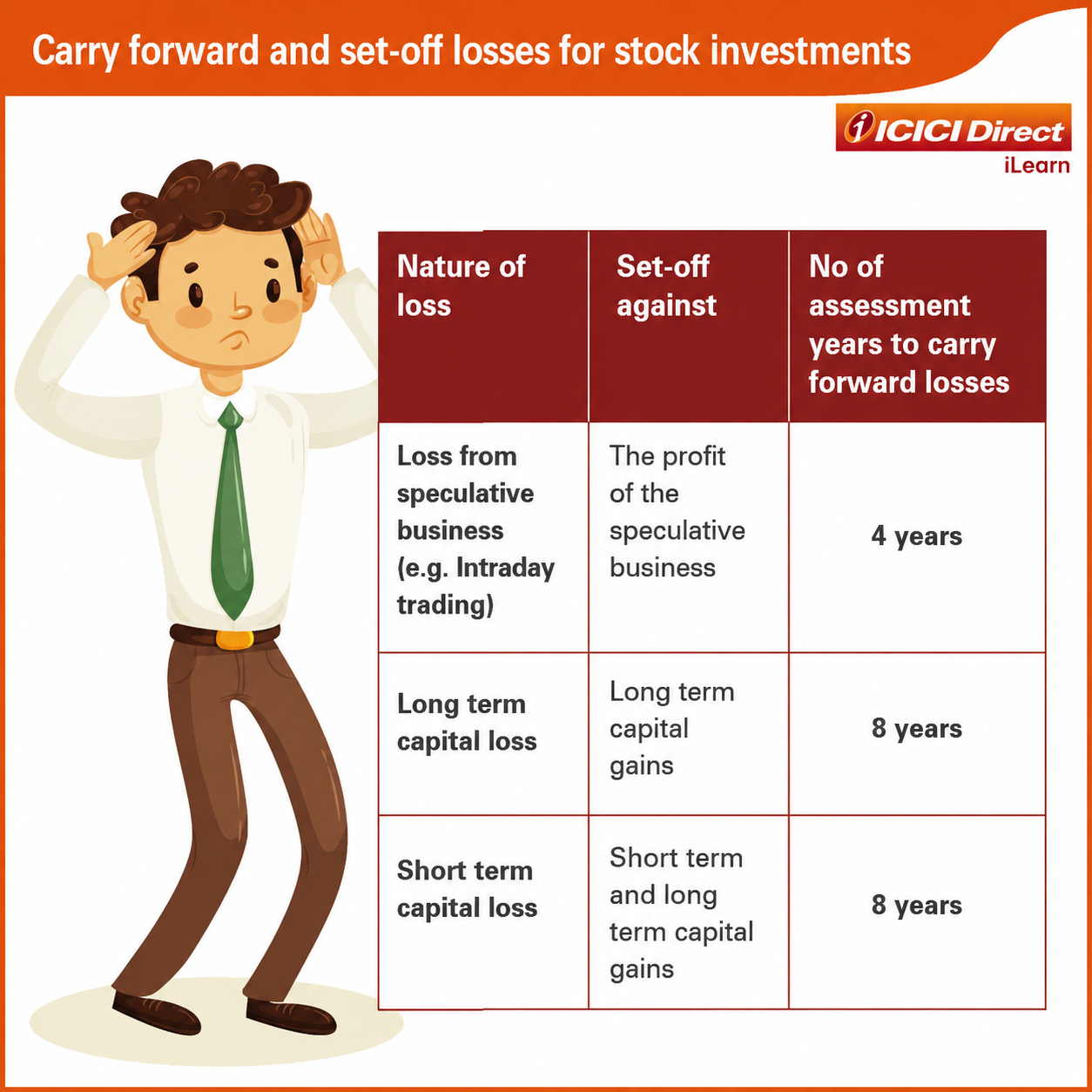
But remember, long term capital loss can only be adjusted towards long term capital gains. However, short term capital loss can be set off against both long term and short term capital gains.
What happens if the capital losses were not adjusted in the same financial year?
Well, you can carry forward your capital loss for eight assessment years from the year in which the loss was incurred.
It is vital to remember that no losses can be carried forward if the return is not filed within the original due date.
What happens if there is a speculative business loss?
In this case, the primary option that you have is to offset any loss from a speculative business against profits from a speculative business carried out by you in that financial year. If that is not an option for you, you can carry forward your loss from the speculative business [intraday trading of equity shares] for over four assessment years after the year wherein you incurred the loss.
Let’s understand both set-off and carry forward option with an example:
|
Financial Year |
Short Term Capital Loss (STCL) |
Long Term Capital Loss (LTCL) |
Short Term Capital Gain (STCG) |
Long Term Capital Gain (LTCG) |
STCG taxable |
LTCG taxable |
Carry forward STCL and LTCL |
|
Year 1 |
2,000 |
1,000 |
STCL - 2,000 |
||||
|
Year 2 |
1,000 |
4,000 |
- |
2,000 (4,000 -2,000) |
- |
STCL - 0 |
|
|
Year 3 |
1000 |
1200 |
- |
7,000 |
- |
2,800 (7,000 - 2,000 - 1,200 - 1,000) |
STCL - 0 |
|
Year 4 |
2,000 |
3,000 |
2,500 |
8,000 |
500 (2500 – 2000) STCG is set-off against STCL |
5,000 (8,000 -3,000) |
STCL - 0 |
As you can observe, both STCL and LTCL of current and previous year are adjusted with LTCG of the same year in order to reduce tax liability.
To sum it up, here’s what you need to know:
*As per FY 26-27
Are there other taxes you should know as well?
Yes, you may need to pay attention to two other taxes - Securities Transaction Tax [STT] and advance tax.
Securities Transaction Tax [STT]: It is the tax payable on any trade you execute on a recognized stock exchange.
However, the STT does not apply to off-market transactions. That means when you transfer your shares from one demat account to another through delivery instructions slip instead of routing the trade through the stock exchange, the STT does not apply.
Here’s what these charges look like –
|
Sr. No. |
Type of transaction |
STT Rate |
|
1 |
Delivery based purchase of an equity share |
0.1% on transaction value |
|
2 |
Delivery based sale of an equity share |
0.1% on transaction value |
|
3 |
Intraday transaction of equity shares |
0.025% on transaction value (applicable only on the sell side transaction) |
* STT rates are as on Jun, 2026
Also Read: Taxation on equity investments
Disclaimer:
Before we wrap up this chapter, please be informed that we have considered the tax rates applicable for the financial year 2026-27, but the rates and clauses may change over time. The details mentioned in this chapter is for educational purpose only. We would advise you to consult a tax advisor before making any transaction.
Summary
- From Financial Year 2021 and onwards, any dividend income you receive from shares of an Indian company is taxable.
- Long term capital loss can only be adjusted towards long term capital gains. However, short term capital loss can be set off against both long term and short term capital gains.
- You may need to pay a Securities Transaction Tax [STT] on any trade you execute on a recognized stock exchange.
We hope that you consider this chapter as your starting point on equity investment taxation and gain deeper understanding on your individual tax assessments with the help of a tax expert. Let's now move onto the next chapter that talks about the micro and macro dynamics of the stock market.






Please Enter Email


 70 Years
 4.4 Star

COMMENT (0)