




Download
iLearn application
Elevate Your Financial Knowledge with the
ICICI Direct iLearn App




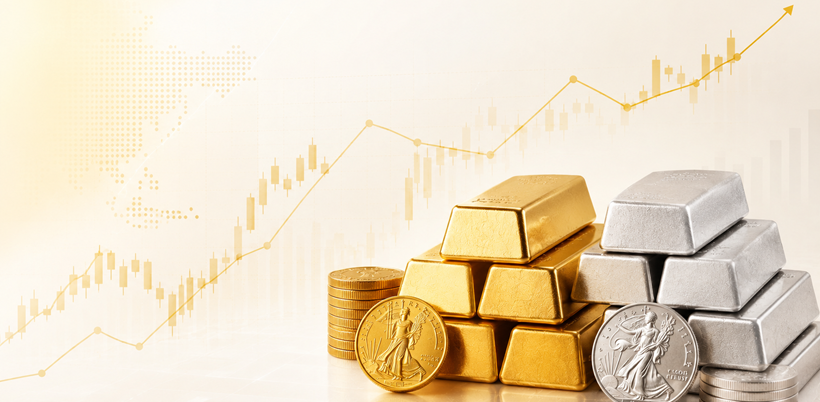
Gold or silver – where should you put your money right now?
For most bullion investors, that decision comes down to instinct, following headlines, or whichever metal has moved more recently.
But chasing momentum often leads to buying what’s already expensive and ignoring what may offer better relative value. That’s where the Gold–Silver Ratio (GSR) becomes useful.
Instead of trying to forecast absolute prices, the ratio compares how expensive gold is relative to silver at a given point in time.
Let’s explore in depth how this metric can be useful for precious metal traders.
The Gold–Silver Ratio is simply the price of gold divided by the price of silver. It tells you how many units of silver it takes to buy one unit of gold at current market prices.
Formula: Gold Price ÷ Silver Price
Watch Video: Gold-Silver Ratio
If you trade on the Multi Commodity Exchange (MCX), there's one small but important detail to keep in mind: gold and silver are quoted in different units on the exchange.
Before calculating the ratio, you need to bring both prices to the same unit. The simplest approach is to convert both to a per-gram price.
For example, if:
Gold-Silver Ratio = 15,900 ÷ 270 = 59:1
In other words, a gram of gold is worth the same as 59 grams of silver.
Here's a simple way to think about what the number is telling you:
These are general guidelines, not hard rules. The ratio can stay elevated or depressed for months or even years before reversing, so it's important to look at the broader context before acting on it.
Several real-world factors influence the Gold–Silver Ratio, including:
During uncertainty — geopolitical tensions, recessions, or financial stress — investors usually move toward gold for safety, pushing the ratio higher. In stronger economic cycles, silver tends to benefit more from industrial activity, pulling the ratio lower.
Silver isn’t just a precious metal; it’s heavily used in solar panels, electronics, EVs, and medical applications. Rising industrial demand often strengthens silver relative to gold, lowering the ratio.
Both metals are seen as hedges against inflation and currency weakness. However, gold typically reacts more directly to central bank policy and interest-rate signals, while silver tends to move with greater volatility.
In risk-off environments, gold usually outperforms as investors seek stability. In risk-on phases, silver often gains faster. The ratio reflects these broader shifts in market sentiment.
Like any tool, the Gold–Silver Ratio comes with its own set of limitations:
For all these reasons, the ratio should never be the only input behind a buy or sell decision.
The Gold–Silver Ratio is a simple yet useful tool that offers meaningful insights into commodity market dynamics.
While it doesn’t reveal much in isolation, combining it with macroeconomic analysis, demand trends, and technical indicators can support more informed decision-making.
For Indian investors and traders, especially those active on MCX, tracking this ratio can offer additional market perspective in both bullion trading and long-term wealth allocation.


Learn how to calculate the break-even point in commodity trading by factoring in brokerage, taxes, and other charges
 831 views
 1 minutes
 01 Jul 2026
Learn how ICICI Direct's Auto Order Slicing automatically splits large commodity orders for faster, seamless execution while complying with exchange limits.
674 views
2 minutes
01 Jul 2026
Learn about a BSDA account, its eligibility criteria, annual maintenance charges, and the latest SEBI rules for Basic Services Demat Accounts.
1 k views
2 minutes
30 Jun 2026


Elevate Your Financial Knowledge with the
ICICI Direct iLearn App
Elevate Your Financial Knowledge with the
ICICI Direct iLearn App
