


-202610121017596081271.jpg)




Download
iLearn application
Elevate Your Financial Knowledge with the
ICICI Direct iLearn App




Almost anyone can open a demat account in India if they meet the KYC and documentation norms. The process is simple, but the rules may differ for adults, minors, NRIs, HUFs and non-individual entities.
A resident individual may complete the process fully online. However, a minor needs a guardian. Additionally, an NRI may need a different account type based on repatriation rules.
Companies, LLPs, trusts and societies need entity documents. Once you know the right category, the demat account opening procedure becomes easy to follow.
A demat account holds your securities in electronic form. These may include shares, ETFs, bonds, mutual fund units and other eligible instruments.
It works like a digital locker for investments. Your bank account holds money, your trading account places buy or sell orders, and your demat account stores the securities after settlement.
Knowing your eligibility helps you apply under the correct investor category. It can also reduce delays during KYC, document checks and account approval.
Before you apply, you should know whether you are opening the account as a resident individual, minor, NRI, HUF or entity.
CDSL lists key KYC attributes, such as name, PAN, address, mobile number, email ID, and income range, for demat-related compliance.
The rules vary by investor group, but the process is not difficult. You only need to submit the correct documents for your category.
Any Indian resident who meets KYC rules can open a demat account. PAN, address proof, bank details, mobile number and email ID are usually required.
A demat account can be opened in a minor’s name and operated by a guardian until the minor becomes a major. SEBI states that a minor cannot be a joint holder in another demat account.
Two or more adults can open a joint demat account. The first holder generally operates the account, while all holders complete KYC.
NRIs can open demat accounts in India. They may need NRE or NRO-linked accounts, depending on whether funds are repatriable or non-repatriable.
An HUF can open a demat account through its Karta. The Karta’s KYC and HUF documents are usually required.
Partnership firms, LLPs, companies, registered societies and trusts can also open demat accounts. They need registration papers, authorised signatory details, PAN and board or partner resolutions where applicable.
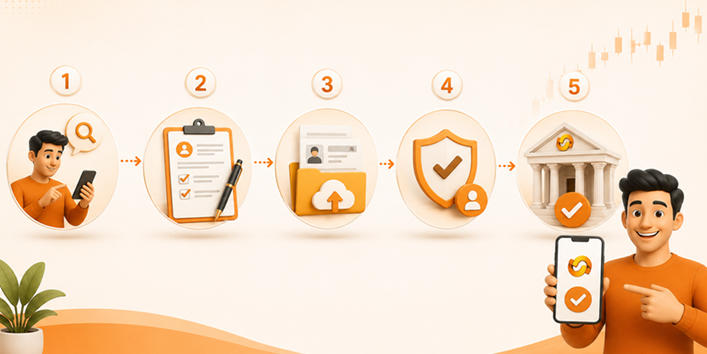
The steps to open a demat account are now mostly digital. CDSL also advises investors to first select a Depository Participant (DP) before opening an account.
Select a SEBI-registered broker or DP. Compare charges, platform quality, service support and investment options. Then enter basic details such as your name, PAN, mobile number, email ID, date of birth and address.
Submit your KYC details and upload clear copies of PAN, address proof, bank proof and other required documents. Make sure the details match your documents to avoid delays.
Most platforms now use video verification. You may need to show your PAN and confirm your identity on camera.
Check all details carefully before signing. Many platforms allow Aadhaar-based OTP eSign to complete the process.
The broker or DP verifies your application, documents and KYC details. Once approved, your demat account is activated, and you can start investing through the linked trading platform.
If all documents are correct, online approval may happen quickly, sometimes on the same day. Delays usually occur due to mismatches in PAN, Aadhaar, bank details, or address proof.
The requirements to open a demat account are simple for most retail investors. The key is to keep the details accurate and up to date.
Adults aged 18 or older can open and operate their own demat account. Minors can have an account through a guardian.
Name, PAN, Aadhaar, mobile number and email ID are key details. PAN is especially important for KYC in the securities market.
Accepted address proofs may include Aadhaar, passport, voter ID, driving licence, bank statement, ration card or registered residence agreement.
Bank linkage enables funds, dividends, and other payments to flow smoothly. A cancelled cheque or bank statement is commonly used as proof.
Video KYC makes onboarding faster. It confirms that the applicant is present and that the identity documents match.
Income proof may be needed for certain products, such as derivatives or margin-related services. It may not be needed for basic equity investing.
The documents required for opening a demat account depend on the applicant type and the product access. Keep scanned copies ready before you open a demat account online.
You may submit a PAN card, Aadhaar card, passport, voter ID, driving licence, ration card, UIN or a valid photo ID issued by the central government, state government, bank, public financial institution, university or professional body.
Accepted proof may include Aadhaar card, passport, voter ID, ration card, driving licence, registered lease or sale agreement, flat maintenance bill, insurance copy, bank statement, self-declaration affidavit or address proof issued by government bodies, regulators, PSUs, colleges, universities or professional bodies.
This may include a recent income tax return, a CA-issued net worth certificate, a salary slip from a registered employer or a bank statement showing salary credit.
A cancelled cheque with your name and IFSC code is commonly accepted. A bank statement may also be used.
PAN is a core document for securities market KYC and is generally mandatory.
Some offline or assisted applications may require one to three passport-size photographs.
Digital KYC has made the demat account opening process faster and easier. It has reduced the need for physical paperwork for many investors.
Aadhaar-based authentication allows verification of details digitally. This makes the online journey quicker than the paper-based onboarding process.
Video IPV is now common on mobile and web. It confirms that the applicant is alive, present and applying personally.
Aadhaar-based OTP eSign can be used to digitally sign the application. This removes the need to print and courier forms in many cases.
Yes, you can open only a demat account to hold securities. This may be useful if you receive shares through transfer, inheritance or dematerialisation.
However, if you want to buy and sell shares in the market, you usually need a trading account too. A demat account stores securities, while a trading account places orders.
Below are some of the common reasons for delay or rejection
It is easy to open a demat account in 2026 if you have your documents in order and your details are in sync with your PAN, Aadhaar and bank account. The process differs for adults, minors, NRIs, and entities, but the core requirements remain the same: KYC, documents, verification, and account details.
ICICI Direct is a good place to start for investors looking for a digital-first experience. Check your eligibility, prepare the required documents, and start the account-opening process.
Yes, a student can open a demat account if the KYC and document requirements are met.
Generally, PAN is mandatory for opening a Demat account, except in limited cases such as minors, eligible ST residents, or exempt entities.
No, there is generally no upper age limit if the applicant can complete KYC.
Yes, subject to DP rules and proper verification of bank details.
If your Aadhaar is not linked to your mobile number, you may need to complete verification through another permitted method, as Aadhaar OTP-based eSign requires a linked mobile number.
Yes, NRIs can open demat accounts in accordance with applicable NRE, NRO, and regulatory rules.
Yes, you can open more than one demat account with different DPs.
It may be completed quickly if all details are correct. Errors or mismatches can delay approval.
Investors are required to provide a choice of nomination or opt out, as per applicable norms.
SEBI revised the BSDA framework to support small investors. The basic limit was increased to ₹10 lakh, with lower AMC slabs for eligible investors.
NRIs generally need a separate PAN card for securities market transactions in India.
Yes, two or more adults can open a joint Demat account.
Yes, many online applications support Aadhaar-based eSign for digital signing.
Video IPV is video-based identity verification. It may be required depending on the DP’s process.
It may be allowed if the applicant’s name is part of the bank account and verification is successful.
You can correct the issue, submit missing documents or reapply as advised by the DP.


Copper is a widely used base metal known for its electrical and thermal conductivity, strength, ductility and corrosion resistance. It is used across electrical wiring, construction, machinery, power infrastructure and several industrial applications.
 244 views
 2 minutes
 09 Oct 2026
Natural Gas is a widely traded energy commodity used for electricity generation, industrial activity, heating and other applications. Its prices can react sharply to weather, supply and demand, inventories, global energy markets and geopolitical developments.
426 views
1 minutes
30 Sep 2026
Gold is more than a precious metal. It is a safe-haven asset, investment avenue, central-bank reserve asset and industrial commodity. For a commodity trader, understanding both Gold's fundamentals and the contract being traded is important.
561 views
3 minutes
23 Sep 2026
Elevate Your Financial Knowledge with the
ICICI Direct iLearn App
Elevate Your Financial Knowledge with the
ICICI Direct iLearn App
