







Download
iLearn application
Elevate Your Financial Knowledge with the
ICICI Direct iLearn App




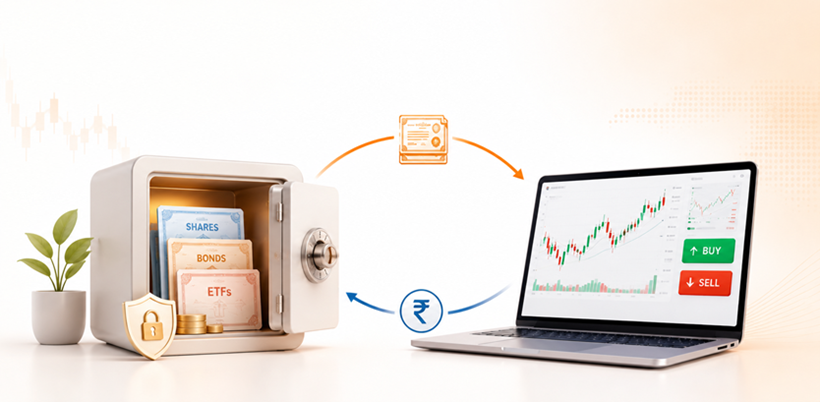
Many first-time investors hear the terms demat account and trading account together and assume they mean the same thing. However, both are important for stock market investing, but they do different jobs.
A demat account stores your securities in electronic form. A trading account helps you place buy and sell orders in the market. Your bank account, trading account and demat account usually work together when you invest in shares.
This article explains the differences between a demat account and a trading account, how both are used, and what beginners should know before opening one.
A demat account is used to hold securities in digital form. It removes the need for physical share certificates and makes ownership easier to manage.
A demat account is an electronic account opened with a Depository Participant, or DP, of NSDL or CDSL. According to SEBI, a demat account is used to hold securities in demat or electronic form.
You can hold shares, ETFs, bonds, mutual fund units and other eligible securities in a demat account. The exact product availability may depend on your broker, DP and platform.
You open a demat account through a SEBI-registered DP. The depository holds securities electronically, while the DP provides account services to the investor.
A demat account supports safe digital holding, faster transfer of securities and smoother corporate actions such as bonus shares or splits. It also makes portfolio tracking easier.
A trading account is used to place buy and sell orders in the securities market. It connects your market orders with the exchange.
A trading account is opened with a stockbroker. Through this account, you can place orders to buy or sell shares and other market instruments.
You can use a trading account to buy and sell shares, apply for IPOs, trade in eligible segments and access market platforms. The available products depend on the broker and the segments you have activated.
A stockbroker provides a trading account. The broker executes your market orders through the stock exchange, subject to regulatory and account requirements.
A demat account stores securities, but it does not place market orders. A trading account is needed to buy or sell shares on the stock exchange.
This table provides a simple comparison of a demat account vs a trading account, so beginners can understand the roles clearly.
| Point | Demat Account | Trading Account |
| Purpose | Holds securities electronically | Places buy and sell orders |
| Function | Store shares and other securities | Executes market transactions |
| Where Securities are Held | In electronic form with depository records | Not held here |
| Role in Buying and Selling | Receives bought securities and debits sold securities | Sends buy and sell orders to the exchange |
| Who Provides the Account | Depository Participant | Stockbroker |
| Link with Bank Account | Linked for payouts and related actions | Linked for funds used in trades |
| Typical Charges Involved | AMC, DP charges and service fees | Brokerage, transaction charges and statutory charges |
The difference between the trading account and the demat account is simple. One helps you trade, while the other holds your purchases. For equity investing, both accounts usually work together.
When you invest in listed shares, the bank account, trading account and demat account move in a connected flow. NISM notes that investors usually need a bank account, a trading account, and a demat account for investing in the securities market.
First, you add money or maintain funds through your linked bank or trading ledger. Next, you place a buy order through the trading account. Once the order is executed and settlement is completed, the shares are credited to your demat account.
When you sell shares, the trading account places the sell order. After the transaction is processed, the shares are debited from your demat account. The sale proceeds are then made available in accordance with settlement and broker rules.
The bank account handles money movement. It supplies funds for buying and receives eligible payouts after selling. In a connected setup, the flow becomes smoother because banking, trading and demat services are linked.
For most equity investors, both accounts are used together. They serve separate roles but complete the same investment journey.
If you want to buy and sell listed shares, you generally need both. The trading account executes the trade, and the demat account receives or delivers the shares.
Investors often open both accounts at the same time, so the difference may not be visible. This is why many people search for “what is a Demat and trading account” when they begin investing.
Think of the trading account as the order-placing account and the demat account as the storage account. A trading account means transactions, and a demat account means holding.
Yes, in principle, you can open only a demat account. This may be useful when your main need is to hold securities rather than actively buy or sell them.
A standalone demat account can hold securities electronically. You may use it to receive transferred shares, inherited securities or dematerialised physical shares.
It may make sense if you only want to hold investments and do not plan to trade immediately. It may also be useful when you are consolidating holdings from another account.
Most beginners want to buy and sell shares through the market. That is why they open a Demat and trading account together for a smoother start.
Yes, you may be able to open a trading account without a demat account, but only for certain types of trading. The requirement depends on what you want to trade and what your broker allows.
A trading account is used to place buy and sell orders. A demat account is used to hold securities such as shares, ETFs and bonds in electronic form.
If you want to buy shares and hold them for delivery, you need a demat account because the shares must be credited somewhere after purchase. Without a demat account, you cannot receive and hold equity shares in your name.
However, if you want to trade in segments where no securities are delivered into your account, such as certain derivatives, currency or commodity contracts, a demat account may not always be required. Even then, many brokers may still ask you to open both accounts together as part of their standard account-opening process.
So, the correct answer is: you can open only a trading account in some cases, but if you want to invest in shares for delivery, you need both a trading account and a demat account.
For beginners, opening both accounts together is usually simpler if the goal is to invest in stocks, ETFs or other securities. If the goal is only to trade a specific segment, check the broker’s requirements, product eligibility and risks before opening the account.
Charges can affect your net returns. Beginners should check both demat and trading charges before applying.
Demat charges may include account-opening charges, annual maintenance charges, DP charges, pledge charges, and other service fees. These vary by DP and plan.
Trading charges may include brokerage, exchange transaction charges, SEBI turnover fees, Securities Transaction Tax, GST and stamp duty. Charges may differ by product and trade type.
A zero opening fee does not always mean the account is low-cost. You should review the full schedule of charges before opening either account.
Eligible small investors may qualify for a Basic Services Demat Account, or BSDA. SEBI revised the BSDA framework in 2024, increasing the holding value limit to ₹10 lakh and reducing AMC charges for eligible investors.
Your account setup should match your investing style. A long-term investor and an active trader may need different features.
Look for low annual charges, a simple portfolio view, easy statements and strong service support. You may not need advanced trading tools at the start.
Compare brokerage, platform speed, order types, research access and trading charges. Even small costs can matter when transactions are frequent.
A 3-in-1 setup links your bank account, trading account and demat account. ICICI Direct offers both setups: a 3-in-1 account that integrates savings, trading and demat services under one platform and a standalone demat and trading account can be linked to any eligible bank account.
Check charges, platform usability, research support, customer service, brand trust, account-opening process, and regulatory registration. Choose an account that is easy to use after it is opened.
Many beginners focus only on opening the account. It is equally important to understand how the account will be used after activation.
A demat account and a trading account are not the same. One stores securities and the other executes trades.
Not reading charges can create surprises later. Review AMC, brokerage, DP charges and other service costs.
Before trading, understand how funds move, how orders are placed and when securities are credited or debited.
A quick opening process is useful, but platform quality also matters. Check whether the app or website is simple, stable and easy to use.
A demat account and a trading account work together, but they do not mean the same thing. A demat account stores securities in electronic form, while a trading account helps you buy and sell in the market.
For most beginners, opening both accounts together is easier because it creates a complete investing setup. A linked bank account then completes the journey by handling money movement. Before choosing any account, compare charges, platform features, service support and long-term usability.
No, a demat account holds securities, while a trading account is used to buy and sell them.
A demat account is used to hold shares in electronic form.
A trading account is used to place buy and sell orders in the market.
Yes, a bank account is used for fund movement, payouts and investment-related payments.
Yes, you can open only a demat account if you only want to hold securities. To buy and sell listed shares, you generally need a trading account too.
BSDA means Basic Services Demat Account. It is meant for eligible small investors and offers lower maintenance charges based on holding value.
Yes, you can have more than one demat account. However, you should track charges, statements and holdings across accounts.
Yes, securities can be transferred from one demat trading account to another through the prescribed DP process.
Yes, you can. However, many beginners open both accounts together because buying and selling shares normally requires a trading account.


Natural Gas is a widely traded energy commodity used for electricity generation, industrial activity, heating and other applications. Its prices can react sharply to weather, supply and demand, inventories, global energy markets and geopolitical developments.
 114 views
 1 minutes
 30 Sep 2026
Gold is more than a precious metal. It is a safe-haven asset, investment avenue, central-bank reserve asset and industrial commodity. For a commodity trader, understanding both Gold's fundamentals and the contract being traded is important.
288 views
3 minutes
23 Sep 2026
Gold is one of the world's most actively traded precious metals and is widely used for investment, jewellery and industrial applications. It is also considered a safe-haven asset during periods of economic or market uncertainty.
651 views
3 minutes
07 Sep 2026
Elevate Your Financial Knowledge with the
ICICI Direct iLearn App
Elevate Your Financial Knowledge with the
ICICI Direct iLearn App
