





Learning Modules Hide
Hide
- Chapter 1: Introduction to Derivatives
- Chapter 2: Futures and Forwards: Know the basics – Part 1
- Chapter 3: Futures and Forwards: Know the basics – Part 2
- Chapter 4: Introduction to Futures
- Chapter 5: Futures Terminology
- Chapter 6: Futures Trading – Part 1
- Chapter 7: Futures Trading – Part 2
- Chapter 8: Advanced Concepts in Futures
- Chapter 9: Participants in the Futures Market
- Chapter 1: Introduction to Derivatives
- Chapter 2: Introduction to Options
- Chapter 3: Options Terminology
- Chapter 4: Options Trading - Long Call (Call Buyer)
- Chapter 5: Options Trading - Short Call (Call Seller)
- Chapter 6: Options Trading - Long Put (Put Buyer)
- Chapter 7: Options Trading - Short Put (Put Seller)
- Chapter 8: Options Summary
- Chapter 9: Advanced Concepts in Options – Part 1
- Chapter 10: Advanced Concepts in Options – Part 2
- Chapter 11: Option Greeks – Part 1
- Chapter 12: Option Greeks – Part 2
- Chapter 13: Option Greeks – Part 3
- Chapter 1: Orientation on Option Strategies
- Chapter 2: Bull Call Spread
- Chapter 3: Bull Put Spread
- Chapter 4: Covered Call
- Chapter 5: Bear Call Spread
- Chapter 6: Bear Put Spread
- Chapter 7: Covered Put
- Chapter 8: Long Call Butterfly
- Chapter 9: Short Straddle
- Chapter 10: Short Strangle
- Chapter 11: Iron Condor
- Chapter 12: Long Straddle
- Chapter 13: Long Strangle
- Chapter 14: Short Call Butterfly
- Chapter 15: Protective Put
- Chapter 16: Protective Call
- Chapter 17: Delta Hedging

Chapter 3: Futures and Forwards: Know the basics – Part 2
Key Risks Associated With Forward Contracts
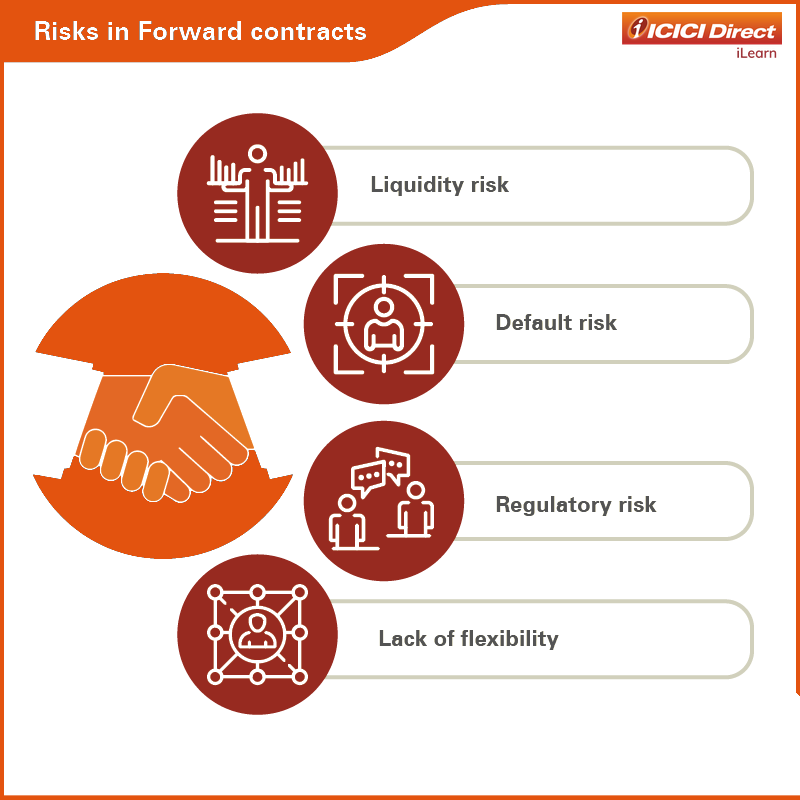
Although Forward contracts are expected within the business fraternity, they come with certain risks. Here are some of the common threats that buyers and sellers could face:
Liquidity risk
To enter into a Forward contract, you need a counterparty who holds the opposite view to yours. Finding such a counterparty is not always easy in the real market.
In the example above, Seema and Anant took out the contract because they held opposite views. Seema expected the tomato price to rise while Anant expected it to fall. What if both parties had expected the price to either rise or fall? No Forward contract would have been possible then.
Taking a position becomes difficult if there aren’t enough participants in the market. Sometimes, you may need a third party or an intermediary to help you find a suitable counterparty. The third-party would charge a fee for this service.
Default risk
Also known as credit risk, this is one of the most significant risks for Forward contracts.
Imagine a scenario where the price of tomatoes falls to Rs 6/kg. Thanks to the Forward contract, this should bring hefty profits to Anant. But Seema might decide not to honour the contract terms because of the loss she would incur. If she defaults, Anant will lose out.
Forward contracts are risky as no payment is exchanged when the contract is initiated. Also, in the absence of day-to-day financial settlements, the risk further increases. So, this remains a risk to both parties.
Regulatory risk
Forward contracts require only the mutual consent of the buyer and the seller. There is no regulator involved. The absence of a regulator makes it challenging to recover the money if one party defaults on the contract.
In Futures, on the other hand, this regulatory risk is minimised. The trades are regulated by an exchange that has safeguards to mitigate default risk by either party.
Lack of flexibility
Forwards can be highly personalised as the contracts are directly between buyer and seller. But once the contracts are drawn up, they don’t offer much flexibility. They have to be executed on the defined expiry date. Buyer and seller may not have the option to exit the contract before expiry.
Should a party wish to close their position, they would need to find another party who will take their place. Owing to the liquidity risk, finding a party to take over the contract for the remaining period can be challenging.
Differences Between Forward Contracts and Futures Contracts
Although Forward and Futures contracts are similar, there are some critical differences between them:
- Contract terms
Forward contracts are based on the mutual consent of the buyer and the seller. So, traders can customise them. On the other hand, Futures contracts follow the rules and regulations of the exchange on which they are traded. That makes them more standardised.
- Default risk
The exchange has several safeguards in place to reduce the risk of default on Futures. But there is no regulatory intervention in a Forward contract. With Forwards, the risk of a party not honouring the contract terms is high.
- Regulation
The exchange on which the Futures contract is traded regulates its terms as well as the transaction. But the Forwards market operates without such a regulator. Parties usually enter into Forwards contracts on their own.
- Initial margin
Futures contracts require a margin payment in advance by both parties. That ensures that both buyer and seller are make a financial commitment towards the contract, which brings down the risk of default. A Forward contract requires no such initial margin, and credit risk remains high as a result.
- Settlement
Forward contracts are settled only on the pre-agreed expiry date. Futures, on the other hand, can be settled at any time before the contract’s expiration. Besides, finding new counterparties to a Futures contract is easy given its high-liquidity through the exchange.
|
Point of distinction |
Forward contracts |
Futures contracts |
|
Contract terms |
Customised |
Standardised |
|
Default risk |
High |
Low |
|
Regulation |
Self-regulated |
Regulated by SEBI |
|
Initial margin |
Not required |
Required |
|
Settlement |
On expiry date |
Daily basis |
Common Derivative Instruments Available in India
There are two kinds of derivatives available for trading on the National Stock Exchange (NSE) and the BSE (formerly the Bombay Stock Exchange). These are Futures and Options.
- A Futures contract is a standardised contract between two participants to buy or sell an underlying asset at a particular future date at a specific price.
- An Options contract is slightly different. It gives one party the option to either execute the contract or not by a particular future date and at a specific price.
You now have a basic idea of the trade-in derivatives. The following chapters will discuss how these derivatives instruments work.
Summary
- Risks involved while trading in Forwards Include, liquidity risk, default risk, regulatory risk and lack of flexibility.
- The main areas of differences between Forwards and Futures lie in their contract terms, their default risk, regulation, initial margin and settlement.
- In India, there are two kinds of derivatives to trade on the NSE and the BSE — Futures and Options.
Part 2 of Futures and Forwards Contracts ends with this chapter. In the next chapter, we dive deeper into Futures to get an in-depth view.






Please Enter Email


 70 Years
 4.4 Star

COMMENT (0)