



-202610121017596081271.jpg)



Download
iLearn application
Elevate Your Financial Knowledge with the
ICICI Direct iLearn App




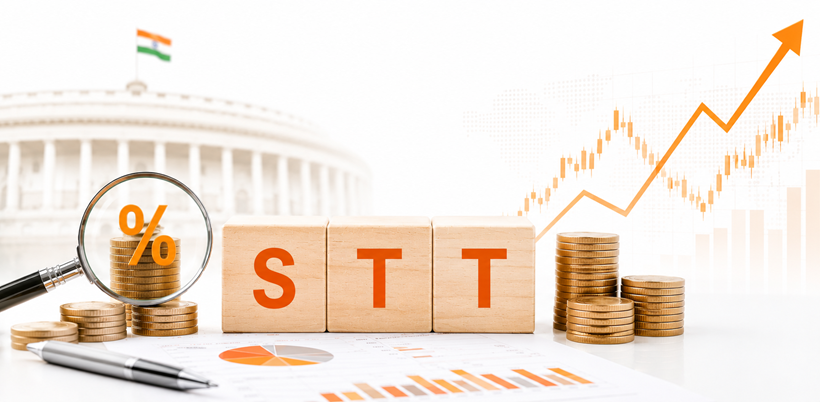
If you actively trade or invest in the stock market, you know that even the smallest changes in cost can make a tangible difference over time. This year’s Budget introduced a couple of changes that could subtly influence your approach to trading starting 1st April 2026.
One of the key changes this year relates to the Securities Transaction Tax (STT), a transaction tax applied whenever you buy or sell securities in the stock market. While most other segments remain unaffected, this change specifically impacts one segment—derivatives.
For a high-volume or short-term trader, this could alter how your trades are planned, and even the potential returns you could expect. But before we get into the impact, let’s take a look at what STT is, who pays it, and a before vs after Budget snapshot of the STT structure.
Introduced in 2004, STT is a transaction tax charged by the Government of India whenever you buy or sell stocks or other securities in the stock market.
The key reasons STT was designed:
STT applies to segments like delivery and intraday equity, futures & options, and equity-oriented mutual funds.
Although STT is automatically collected by stock exchanges, it is essential to understand who actually bears the cost, especially when assessing the impact of the changes introduced in the 2026 Union Budget, followed by Exchanges circulars, NSE/FATAX/73524 & 20260331-7, dated March 31, 2026, announcing revised STT on Futures & Options, as detailed below:
Only a futures seller pays STT. After the changes announced in Budget 2026, high-volume traders would now have to pay 0.05% STT on their trades.
Options trading is one of the most impacted areas, given the large retail participation.
Based on the premium of the option sold, the options seller would need to pay 0.15% STT. However, if the option is exercised by the options buyer, the buyer would have to pay the same amount (0.15%) as STT.
Due to the rapid growth in the F&O segment, policymakers reassessed the earlier framework, leading to a policy shift announced in Budget 2026.
With this change, which comes into effect on 1st April 2026, the Government aims to discourage short-term, high-frequency trading in the F&O segment.
The table below highlights the revised STT rates for F&O post-budget vs pre-budget.
|
Instrument |
Type of Transaction |
Rate of STT |
Rate of STT |
Change % |
|
(Pre-Budget’26) |
(Post-Budget’26) |
|||
|
Options |
Sale of Option (Premium) |
0.10% |
0.15% |
50% |
|
Sale of Option (Exercised) |
0.13% |
0.15% |
20% |
|
|
Futures |
Sale of Future |
0.02% |
0.05% |
150% |
The revised STT rates have significantly changed trading economics, especially in the F&O segment. While long-term investors remain largely unaffected, active and frequent F&O traders are most likely to feel the impact.
In summary, the revised STT framework changes trading dynamics in the F&O segment, while the cash market remains untouched. These changes may encourage improved risk management, more well-thought-out trade setups, and, arguably, a more resilient capital market.
NSE circular NSE/FATAX/73524, dated March 31, 2026
BSE notice no.: 20260331-7, dated March 31, 2026
SEBI Notification No. So 1059(E), Dated 28 September, 2004 on Securities Transaction Tax Rules, 2004


Understand contango in commodity trading, how futures prices differ from spot prices, and how financing, storage and insurance costs influence commodity pricing.
 109 views
 1 minutes
 19 Oct 2026
Copper is a widely used base metal known for its electrical and thermal conductivity, strength, ductility and corrosion resistance. It is used across electrical wiring, construction, machinery, power infrastructure and several industrial applications.
348 views
2 minutes
09 Oct 2026
Natural Gas is a widely traded energy commodity used for electricity generation, industrial activity, heating and other applications. Its prices can react sharply to weather, supply and demand, inventories, global energy markets and geopolitical developments.
588 views
1 minutes
30 Sep 2026

Elevate Your Financial Knowledge with the
ICICI Direct iLearn App
Elevate Your Financial Knowledge with the
ICICI Direct iLearn App
