






Download
ICICI Direct app
Invest, Track, and Manage your Portfolio Anytime, Anywhere




-202603261052198984066.png)
Investment strategy calls for discipline, balance, and a clear view across markets. This is not a year that rewards extreme positioning. Geopolitical tensions have raised risk premiums, kept energy prices elevated, strengthened the US dollar, and added pressure on capital flows into emerging markets.
At the same time, recent corrections have reset valuations in several segments, bringing parts of the market closer to long-term averages and creating more selective entry opportunities.
Against this backdrop, portfolio construction matters more than chasing short-term momentum. Rather than reacting to fear or leaning too heavily on a single geography or asset class, you need an approach that spreads risk while staying ready for opportunity.
|
Asset class |
What’s happening |
What is driving the stance |
|
Global markets |
Near-term volatility likely to persist |
Geopolitical conflict, higher energy prices, stronger USD, and capital outflows from emerging markets |
|
Equities |
Maintain equal weight, use dips for gradual accumulation |
Valuations are below long-term averages, sentiment is near fear levels, and policy support from the RBI, government actions, and trade deals may help |
|
Fixed income |
Prefer fixed deposits and short-term high-quality carry-oriented products |
Long bond yields may stay firm, especially if the conflict extends |
|
Gold |
Maintain strategic allocation, avoid chasing the rally |
Precious metals have strong momentum but are overvalued, crowded, and vulnerable to volatility, while a stronger USD may cap upside |
When geopolitical tensions rise, investors typically move towards safe haven assets. In the current environment, that shift is becoming increasingly visible across global markets. Risk premiums have moved higher, energy prices have remained under pressure, and emerging markets are seeing capital outflows as investors turn more cautious.
At the same time, the US dollar has strengthened as demand for safer assets has picked up. The US economy is also relatively better placed to absorb higher oil prices, largely because it is a net energy exporter. This has further reinforced the dollar’s position during the ongoing period of uncertainty.
The impact is also visible in currency markets, where several major currencies have weakened against the US dollar since the conflict began. Even gold, which is often viewed as a defensive asset during uncertain times, has not remained immune and has seen a sharp correction in this phase.
|
Country / Asset |
Change against USD (%) |
|
Argentina |
0.5 |
|
USD |
0.0 |
|
Hong Kong |
-0.1 |
|
China |
-0.6 |
|
Canada |
-0.6 |
|
Turkey |
-0.8 |
|
UK |
-1.0 |
|
Malaysia |
-1.1 |
|
Indonesia |
-1.3 |
|
Singapore |
-1.3 |
|
Australia |
-1.3 |
|
Japan |
-2.0 |
|
Euro |
-2.0 |
|
Taiwan |
-2.4 |
|
Switzerland |
-2.4 |
|
INR |
-2.9 |
|
Brazil |
-3.6 |
|
Mexico |
-3.8 |
|
South Korea |
-4.3 |
|
Thailand |
-5.2 |
|
South Africa |
-6.5 |
|
Russia |
-7.5 |
|
Gold |
-14.9 |
That sets up a key debate for investors: investing in gold vs USD. Experts and investors do not argue for abandoning gold. Instead, they suggest staying with strategic allocation while recognising that a firm USD may restrain further upside in gold in the near term.
Indian markets are experiencing sharp volatility due to a rare, supply-chain-driven geopolitical shock. Markets have corrected around 13% since the war started, and the small-cap index is down roughly 22% from its all-time highs. Even so, the recommendation is not to retreat. It is to deploy gradually and move towards an equal-weight equity stance during market dips.
Analysts have compared the recent market response with the way markets behaved during earlier geopolitical shocks. Their view is fairly consistent. While such events often trigger short-term volatility, that phase does not usually define market direction over the longer term.
As uncertainty begins to ease, markets tend to shift their focus back to economic fundamentals, earnings, liquidity, and valuations. Over the following 6 to 12 months, price action often becomes more closely aligned with these underlying factors rather than the initial shock itself.
|
Conflict |
Days till market bottom |
Change in crude prices (%) |
Nifty 50 correction (%) |
6M forward return (%) |
1Y forward return (%) |
|
Iraq War (Aug 1990) |
176 |
-9 |
-12 |
55 |
106 |
|
Kargil War (Mar 1999) |
52 |
36 |
-12 |
52 |
54 |
|
World Trade Centre (Sept 2001) |
10 |
-12 |
-17 |
34 |
14 |
|
Mumbai Attack (Nov 2008) |
6 |
-16 |
-3 |
70 |
93 |
|
Arab Spring (Dec 2010) |
55 |
10 |
-12 |
-1 |
3 |
|
Uri Surgical Strikes (Sept 2016) |
1 |
1 |
-2 |
6 |
14 |
|
Pulwama Attack (Feb 2019) |
5 |
3 |
-1 |
4 |
14 |
|
Russia-Ukraine War (Feb 2022) |
114 |
17 |
-10 |
19 |
23 |
|
Israel-Hamas Conflict (Oct 2023) |
19 |
4 |
-4 |
19 |
28 |
|
Operation Sindoor (May 2025) |
2 |
5 |
-2 |
6 |
NA |
|
US-Iran Conflict (Mar 2026) |
23 |
56 |
-10 |
NA |
NA |
This is probably the reason why the experts are leaning towards buying the dip rather than trying to time the exact bottom.
Experts continue to hold an equal-weight view on equities because the broader picture looks more balanced than it did a few months ago. Their stance is supported by four key factors: cooling valuations, supportive market-cycle patterns, improved sentiment after the correction, and signs that growth momentum is still intact.
One of the biggest reasons behind this view is that India no longer appears as relatively expensive as it once did. Reports indicate that India’s current valuation relative to global markets is now around 9% below its long-term average. This suggests the market has moved out of an overvalued zone, making the case for equities more balanced.
History also offers some support. Periods of consolidation in Indian equities have often been followed by renewed outperformance. Analysts note that Indian market downcycles have typically not lasted beyond 19 months, and have usually been followed by a reversal over the next 18 months. This pattern supports the view that extended weakness does not necessarily signal a prolonged negative phase.
|
Index |
Bull phase |
Consolidation |
Bull phase |
Consolidation |
|
|
Jan 2020 to Oct 2021 |
Oct 2021 to Mar 2023 |
Mar 2023 to Sep 2024 |
Sep 2024 to Mar 2026 |
|
Nifty 50 |
55% |
-7% |
58% |
-13% |
|
Nifty 500 |
64% |
-9% |
74% |
-15% |
|
Nifty Midcap 150 |
96% |
-8% |
102% |
-12% |
|
Nifty Smallcap 250 |
108% |
-12% |
114% |
-22% |
The latest correction has made valuations more reasonable. Nifty is now trading at 17.5x one-year forward earnings, which is below both its 5-year average of 19.6x and its 10-year average of 18.6x. For perspective, studies show that in the post-COVID period, valuations had fallen to 16.8x one-year forward earnings during the Russia-Ukraine conflict.
Sentiment has also turned more supportive. The India Equity Sentiment Indicator has slipped into oversold territory, which generally points to more attractive entry levels for investors willing to take a staggered approach.
Even with near-term risks from geopolitical developments and supply chain disruptions, high-frequency indicators continue to suggest that growth momentum remains in place. Demand is expected to stay supported by tax cuts, the delayed impact of monetary easing, and progress on key trade deals. Together, these factors help explain why experts are not turning outright negative on equities despite the volatility.
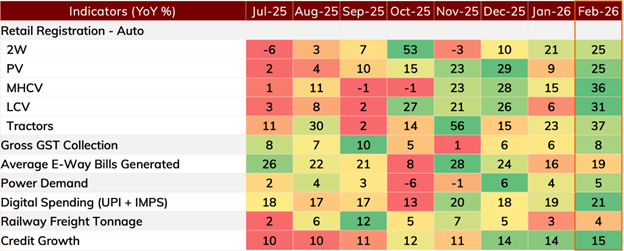
Analysts give a direct framework for fresh equity deployment.
It is also noted that, historically, the Nifty 50 has fallen by 10% to 15% every year from recent highs, the Nifty Midcap 150 by 15% to 25%, and the Nifty Smallcap 100 by 20% to 35%. That is why the current large-cap decline is seen as within historical range, while a gradual allocation to small-cap funds can also be considered.
Valuations in the mid- and small-cap space are no longer as stretched as they were at their 2024 peak. After the recent correction, the segment looks more reasonable, which is why many reports now see the current volatility as an opportunity for selective accumulation rather than a reason to stay away completely.
The shift is also visible beneath the surface. Over the past two years, several companies that were earlier trading at expensive valuations have moved into lower valuation bands. This has improved the risk-reward equation and made staggered additions to mid- and small-cap exposure look more sensible in the current market environment.
|
Price-to-book |
2018 |
2019 |
2020 |
2021 |
2022 |
2023 |
2024 |
2025 |
2026 YTD |
|
0 to 1 |
11 |
20 |
18 |
10 |
8 |
3 |
1 |
4 |
4 |
|
1 to 2 |
21 |
22 |
20 |
18 |
19 |
14 |
13 |
9 |
18 |
|
2 to 3 |
16 |
13 |
14 |
13 |
17 |
15 |
13 |
20 |
18 |
|
3 to 6 |
31 |
29 |
25 |
22 |
26 |
27 |
24 |
32 |
28 |
|
Above 6 |
20 |
16 |
22 |
36 |
30 |
41 |
49 |
35 |
32 |
Analysts view Q3FY26 as an important turning point for domestic equities, as earnings growth showed a clear improvement across the market.
Domestic demand also offered support during the quarter. Reduced GST rates that came into effect on 22 September 2025 helped lift consumption, with the auto sector reporting around 20% volume growth and FMCG reporting high single-digit volume growth.
Looking ahead, analysts expect earnings growth over FY26 to FY28E to be driven by telecom, metals, capital goods, and BFSI, with Nifty earnings projected to grow at a 15% CAGR over the period.
In the current phase, metals and financials have outperformed, while realty, IT, and FMCG have underperformed.
|
Sector |
Bull phase 1 (Jan’20 - 27 Sep’24) |
Consolidation 1 (Oct'21 - Mar'23)
|
Bull phase 2 (Mar'23 - 27 Sep’24)
|
Current consolidation (Sep'24 - Mar'26)
|
|
Realty |
83% |
-30% |
195% |
-41% |
|
Infrastructure |
67% |
-3% |
96% |
-10% |
|
IT |
139% |
-21% |
56% |
-28% |
|
Bank |
24% |
0% |
39% |
-5% |
|
Metal |
131% |
-11% |
89% |
10% |
|
Financial Services |
32% |
-7% |
44% |
-4% |
|
Energy |
66% |
-7% |
101% |
-19% |
|
Pharma |
84% |
-19% |
103% |
-4% |
|
FMCG |
42% |
12% |
50% |
-29% |
|
Auto |
48% |
4% |
131% |
-12% |
Experts see the auto sector at the meeting point of three powerful forces.
Even after that, the sector has underperformed after the US-Iran conflict, with the auto index down around 11% versus roughly 7% for the Nifty. Near-term concerns include higher raw material costs, especially metals and crude derivatives such as plastics, muted economic sentiment, and shortages in industrial gases used in manufacturing.
Still, the investors remain positive on the auto space from a medium- to long-term perspective. Reports say the sector is well placed for double-digit value growth over the next 3 to 5 years, supported by structural drivers, premiumisation, the rollout of the 8th Pay Commission, and lower interest rates. They also flag one notable possibility: the current conflict could increase domestic EV adoption due to renewed focus on energy security.
Analysts remain constructive on the metals sector, with both ferrous and non-ferrous segments supported by favourable demand-supply trends.
In ferrous metals, the support comes from upbeat domestic demand, timely capacity expansion by major steel players, and improving profitability. It also notes that the government imposed a 12% safeguard duty on steel imports into India in mid-December 2025, which helped domestic steel spot prices recover by about ₹7,000 per tonne from December 2025 lows of roughly ₹46,500 per tonne.
Analysts expect steel companies to report a meaningful improvement in profitability from Q4FY26 onwards, although part of this benefit may be offset by higher coking coal costs. They also believe that ongoing geopolitical tensions are unlikely to significantly disrupt domestic steel production, since exports account for less than 6% of India’s total steel output.
The outlook for non-ferrous metals also remains supportive. Supply-side disruptions, along with steady demand from emerging sectors such as electric vehicles and renewable energy, are expected to keep prices firm through 2026. In addition, the Middle East contributes nearly 8% of global aluminium production, which means any disruption in the region could push up LME aluminium prices and create a favourable environment for primary aluminium producers in India.
This is one of the clearest pressure points that can hamper your investment strategy.
That is why the crude oil impact on FMCG is negative in the short run. Higher crude derivatives and edible oil prices are expected to affect margins. On paints, the view is also cautious.
Market data suggests that if crude remains above $100 per barrel in the coming months, it will hurt profitability, as crude-linked inputs make up 20% to 25% of paint companies’ input costs. Some companies have already taken 2% to 3% price hikes, but the report says that will not fully offset the increase in crude prices.
Data also warns that supply disruptions could push up food inflation and affect consumer demand in the coming quarters. As a result, FMCG and paints performance is expected to stay muted in H1FY27, with recovery likely in H2FY27.
The warfare has shifted from conventional troop clashes to technology-driven, AI-enabled autonomous systems, drone swarms, and cyber warfare. That creates a structural opportunity for domestic defence companies aligned with scalable, low-cost, and electronic warfare capabilities.
Hence, companies involved in integrated defence systems, indigenous loitering munitions, counter-drone systems, electronic warfare, and radars are likely beneficiaries. At the same time, valuations of many defence companies are expensive, which means an ETF approach may not suit all investors.
The expert’s IT view is selective rather than negative.
They say markets are currently focused on AI-led productivity gains and whether those gains could compress traditional revenue streams faster than enterprises reinvest savings into new digital programmes. This is described as AI diffusion risk.
Still, many reports argue that the Gen AI revenue impact is manageable in the near term. They estimate that Gen AI-led pricing deflation will have an annual revenue impact of only 2% to 3% over the next two to three years. Moreover, industry leaders predict that the industry could see an AI-first services opportunity of US$300 to 400 billion by 2030.
The partnership announcements at the India AI summit are a sign of a strategic pivot similar to earlier cloud and digital transitions. This means investors should watch three things closely:
Lastly, the staggered investment through IT ETFs over the next few quarters could be a prudent approach.
In the current setup, the preference is for fixed deposits and short-term high-quality carry-oriented products, not long-duration bonds. That makes the FD vs bonds stance straightforward. Investors favour safety, quality, and shorter duration because long bond yields may stay firm.
According to reports, the Indian Overnight Indexed Swap rates have moved sharply higher in recent weeks. The 1-year OIS is already close to 5.95%, suggesting the market is pricing in two or three rate hikes over the next year if the current conflict persists. Even so, expect status quo on the policy rate for now, noting that both India and US CPI prints came broadly as expected.
|
Indicator |
Reading / View |
|
Policy rate view |
Status quo expected |
|
1-year OIS |
Close to 5.95% |
|
Market pricing |
Two or three rate hikes over the next year if the conflict extends |
|
Preferred products |
Fixed deposits and short-term high-quality carry-oriented products |
|
View on long bonds |
Yields may stay firm |
|
FYTD gross state borrowing |
INR 11.2 trillion, up 19% YoY |
|
Q4 borrowing so far |
Up 20% YoY |
|
SDL spreads |
Elevated, may remain firm because of higher borrowing |
|
10-year G-Sec yield |
6.70% in Feb 2026 |
|
FYTD Feb G-Sec yield |
6.45% |
|
Q2 FY26 GDP growth |
8.2% |
|
FY26 GDP growth expectation |
7.3%, with improvement expected in private consumption |
*Policy rates may stay unchanged for now, but longer-duration fixed income may remain under pressure if geopolitical risk keeps the market nervous.
Gold remains important in portfolio construction, but the experts do not encourage chasing it aggressively.
Experts' view on the gold price forecast March 2026 is balanced:
The long-term return profile is still noteworthy. Data shows that gold delivered 3% CAGR from 1975 to 2000 and 9% CAGR from 2001 to 2022. That is why the recommendation is not to exit gold, but to maintain a strategic allocation rather than treat it as a momentum chase.
Crude oil prices rose 5.1% in February 2026, largely due to geopolitical tensions in the Gulf region and broader global political uncertainty that revived supply fears. That keeps crude central not only to inflation and macro positioning, but also to how you think about FMCG, paints, and import-sensitive sectors.
|
Period |
Return |
|
1 month |
5.1% |
|
CYTD |
19.8% |
|
FYTD |
-1.5% |
|
1 year |
0.1% |
|
2 years |
-5.8% |
|
3 years |
-4.4% |
|
Period |
Net imports |
|
FY21 |
55.6 |
|
FY22 |
99.9 |
|
FY23 |
127.1 |
|
FY24 |
108.6 |
|
FY25 |
116.4 |
|
FYTD 25 (Jan 2025) |
97.5 |
|
FYTD 26 (Jan 2026) |
85.7 |
The investment playbook for March 2026 is shaped neither by panic nor by unchecked optimism. It is shaped by balance. In a market defined by geopolitical uncertainty, shifting capital flows, and changing valuations, the case is not for extreme positioning but for steady, disciplined allocation across asset classes.
Equities continue to merit an equal-weight stance, with a clear preference for staggered deployment during market corrections rather than aggressive lump-sum positioning. In fixed income, the tilt remains towards fixed deposits and short-duration, high-quality carry products, especially as long bond yields may stay elevated. Gold still has a place in the portfolio as a strategic diversifier, but it is better viewed as a long-term allocation rather than a trade to chase after a strong run-up.
For investors navigating the 2026 correction, the message is clear: stay disciplined, not reactive. Use market dips to build exposure gradually, keep your portfolio aligned with your risk profile, and remain selective across sectors and asset classes.
In the current environment, the stronger opportunities appear to be in areas where fundamentals remain resilient despite volatility, while the bigger risks lie in segments still facing pressure from high energy prices, margin stress, or stretched valuations.
Disclaimer: ICICI Securities Ltd.( I-Sec). Registered office of I-Sec is at ICICI Securities Ltd. - ICICI Centre, H. T. Parekh Marg, Churchgate, Mumbai - 400020, India, Tel No : 022 - 2288 2460, 022 - 2288 2470. The contents herein above shall not be considered as an invitation or persuasion to trade or invest. Investments in securities market are subject to market risks, read all the related documents carefully before investing. I-Sec and affiliates accept no liabilities for any loss or damage of any kind arising out of any actions taken in reliance thereon. The contents are solely for informational and educational purpose.


The Reserve Bank of India (RBI) held its 63rd Monetary Policy Committee (MPC) meeting from October 5 to 7, 2026. It raised the policy repo rate by 25 basis points. The stance was also changed from ‘neutral’ to ‘calibrated tightening’. India’s economy continued to show strong momentum, with real Gross Domestic Product (GDP) growing by 7.8% in Q1 FY2026-27. While inflation rose to 4.8% in August, the overall economic outlook remained positive. However, rise in crude oil prices amid renewed tensions in West Asia added to global uncertainties. This made it imperative for the RBI to strike a balance between the economic growth and price stability....
Jio Platforms is the company behind Reliance Jio's mobile network, home broadband and a growing line-up of AI-powered products. The company filed its Draft Red Herring Prospectus (DRHP) with SEBI on June 19, 2026, and Red Herring Prospectus (RHP) on October 14, 2026. The Jio Platforms IPO opens on October 21, 2026 and closes on October 23, 2026. The RHP gives details about how the Jio Platforms IPO is structured, who currently owns the company, and where the raised money will be used. This article analyses RHP and says about how the issue is structured, how it is divided among investors, who is managing it, who owns the company today, the numbers behind the business and the market it operates in. It is for information only and not an investment advice....
The Natco Pharma Ltd. rights issue is proposed at ₹750 per share, with eligible shareholders entitled to two rights equity shares for every 21 fully paid-up equity shares held on the record date. The issue is scheduled to open on October 12, 2026, and close on October 22, 2026. The pharmaceutical company plans to raise up to ₹1,279.35 crore through the issue, subject to full subscription and the finalisation of the basis of allotment....


Invest, Track, and Manage your Portfolio Anytime, Anywhere
Invest, Track, and Manage your Portfolio Anytime, Anywhere
