



-202610121017596081271.jpg)



Download
iLearn application
Elevate Your Financial Knowledge with the
ICICI Direct iLearn App




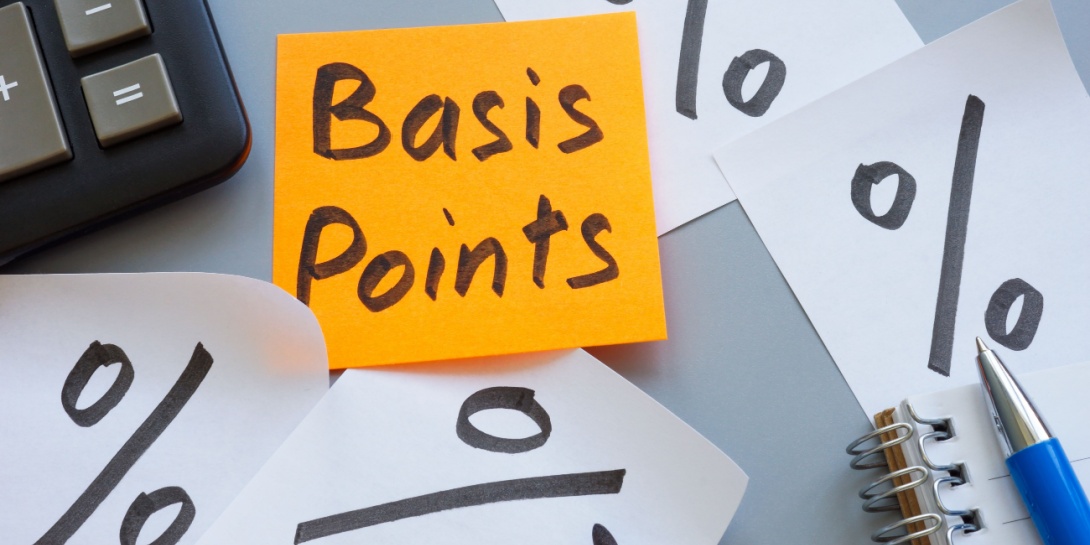
Have you noticed when interest rates are changed, how they are announced? Aren’t the change in quotes as basis points? For instance, a few months back, the US FED reduced its interest rate by 50 bps, which you may have seen or read in the news, isn’t it? So, what does this bps mean? This article will help you understand Basis Points, calculations, their importance, and more.
BPS or basis points can be defined as a measure of financial instruments price change or interest rate change. One bps means 0.01 percent or 1/100th of 1 percent. So, if you see a change of 25 bps in interest rate, this means the interest rate has changed by 0.25%.
The term “basis” here represents the base difference between interest rates or prices of financial instruments. Since the changes can be very small, thus fraction of a percentage is used to describe or measure these changes but they hold immense importance at the same time even if the change is tiny.
Initially, basis point was used in the bond market to measure the yield of bonds, but now it is widely used across financial markets for different instruments. Whether you talk about fixed deposits (FD) or the stock market, the basis point is used everywhere.
Now basis points when used for the calculation of different financial instruments, are usually converted to percentages. Since most of the time the change in interest rates, or other financial instruments prices or yield is below 1%, for ease of understanding basis points are used to measure the same, and for using basis points for further calculation, it is converted to percentage.
For instance, suppose RBI changes the repo rate by 25 basis points. The prevailing rate is 6% (suppose) if RBI has increased 25 basis points then the new repo rate would be 6.25% and if RBI has decreased 25 basis points, then it would be 5.75%.
Therefore, 25 basis points are converted to 0.25% by dividing the same by 100.
Percentage = Basis points/ 100
Percentage = 25 / 100
Percentage = 0.25%
It can go the other way around as well. So, if the change is mentioned in percentage and you want to convert it to basis points, then all you need to do is multiply the percentage figure by 100.
Basis points = Percentage*100
Basis points = 0.25*100
Basis points = 25
Basis points or bps are important for understanding investments of any kind, you have to use this for most financial instruments and the reason is pretty simple that is basis points provide a very clear picture of change in the interest rates and prices in both absolute and relative terms.
Coming to fixed deposits, are still India’s favourite savings and investment instruments. With the risk-free feature along with higher interest rates, FDs make a good option for accumulating wealth. Now for FDs, the interest rate is crucial and that is where the basis point comes in.
Apart from an intricate part of fixed deposits, basis points are used in other financial instruments as well.
So, basis points are crucial for analyzing financial instruments the reason being its ability to portray both quantitative change and qualitative change. You can check how much the interest rate yields or prices have changed, and then you can understand the impact of the same, or compare with its peers to understand and analyze the movement. This helps in making wiser investment decisions.


Understand contango in commodity trading, how futures prices differ from spot prices, and how financing, storage and insurance costs influence commodity pricing.
 199 views
 1 minutes
 19 Oct 2026
Copper is a widely used base metal known for its electrical and thermal conductivity, strength, ductility and corrosion resistance. It is used across electrical wiring, construction, machinery, power infrastructure and several industrial applications.
418 views
2 minutes
09 Oct 2026
Natural Gas is a widely traded energy commodity used for electricity generation, industrial activity, heating and other applications. Its prices can react sharply to weather, supply and demand, inventories, global energy markets and geopolitical developments.
689 views
1 minutes
30 Sep 2026


Elevate Your Financial Knowledge with the
ICICI Direct iLearn App
Elevate Your Financial Knowledge with the
ICICI Direct iLearn App
