






Download
iLearn application
Elevate Your Financial Knowledge with the
ICICI Direct iLearn App




In the world of commodities trading, investors are always looking for new ways to manage risk and maximize profits. One innovation that has gained popularity is the use of commodity mini contracts. These contracts allow traders to buy and sell a smaller quantity of a commodity than traditional futures contracts, which can be more expensive and carry higher risks.
Mini contracts in commodity derivatives trading are the miniature contracts of larger and regular contracts. These contracts are intended for retail investors to trade as well as MSMEs engaged in the business of metal trading for hedging their price risk. Further, these contracts are smaller minimum lot size suitable for those investors who want to trade with a smaller margin. The price movement in these mini contracts is similar to the larger contract.
Recently, Multi Commodity Exchange (MCX) of India Limited relaunched mini contracts in Aluminium, Lead, Zinc, Crude Oil and Natural Gas following demand from the market participants as well as brokers to attract retail customers as well as MSMEs having smaller quantity exposure in these commodities. Mini contracts were very popular amongst investors prior to 2019, however, these contracts were discontinued as the metal contracts were converted into deliverable contracts where the minimum deliverable lot size was the challenge. At that time, these mini contracts were contributing nearly 30% of the total exchange turnover.
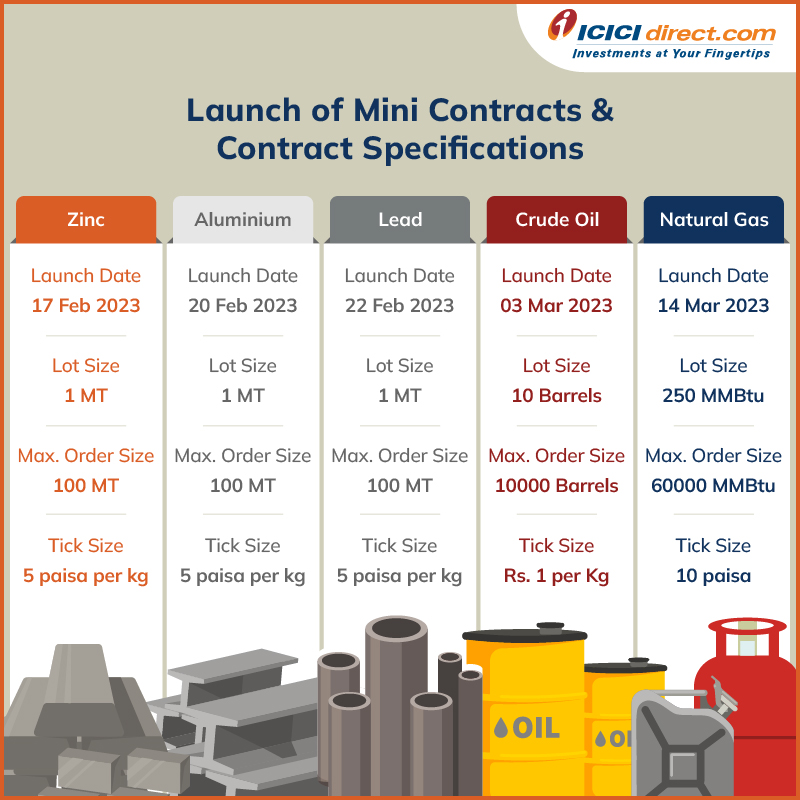
Commodity mini contracts offer retail investors a convenient and cost-effective way to gain exposure to a range of commodities. These contracts have lower margin requirements, tighter bid-ask spreads, and provide price discovery for smaller amounts of commodities. However, investors should be aware of the risks associated with commodity mini contracts, including volatility, leverage, liquidity, and market risk. Small and medium enterprise having a physical market exposure for smaller quantity can benefit from these mini contracts. In total, the mini contracts are paradise for retail investors to trade with smaller capital as well as MSMEs to hedge their smaller quantity price risk.


Gold can react to inflation data, while crude oil may jump after an inventory report or geopolitical disruption.
 393 views
 4 minutes
 21 Jul 2026
Understand how crude oil trading works on MCX and also learn about contract sizes, expiry, trading hours, global benchmarks, price drivers and risks before you trade.
628 views
2 minutes
20 Jul 2026
Learn how to calculate the break-even point in commodity trading by factoring in brokerage, taxes, and other charges
1 k views
1 minutes
01 Jul 2026

Elevate Your Financial Knowledge with the
ICICI Direct iLearn App
Elevate Your Financial Knowledge with the
ICICI Direct iLearn App
