





Download
iLearn application
Elevate Your Financial Knowledge with the
ICICI Direct iLearn App





One of the stages in the IPO process is the bidding or subscription. When a company files for an initial public offering (IPO) and its application gets a nod from the Securities and Exchange Board of India (SEBI), there are several things it has to get in order as part of its public issue process.
Starting from hiring a merchant banker, filing a draft prospectus, conducting due diligence, valuation of the IPO, to the allotment of shares and listing. This is a broad outline of the steps involved in the process of a company going public.
Prior to share allotment, retails investors get a period within which they can apply to the IPO or bid for the company's shares. This can be done either online or offline.
There is the option of applying online via your broker or going the offline way. When applying online, you now have the option of making the payment for the shares you bid for via the unified payment interface (UPI) option. All you are required to do is provide a UPI ID linked to your bank account. You can either use an existing UPI ID or create a new one.
Once you have applied for the IPO, your broker uploads the bid details onto the stock exchange's platform, and the applicant's UPI ID is also shared with the escrow bank. Thereafter, the escrow bank requests the authority to block funds in your bank account (depending on the number of shares you have applied for). If you are allotted the same number of shares as applied for, the money is then debited from your account. Before the money is blocked, applicants are sent an intimation message on their registered mobile number linked to the said bank account.
In case the number of shares allotted are less than what you had applied for, the excess funds blocked in your account are released.
The same mechanism (also called ASBA- Applications Supported by Blocked Amount) is applied even if you pay for an IPO directly from your bank account without using your UPI ID. The alternative payment option is to use your Net Banking ASBA service if offered by your bank.
It is at this stage that you get to know how much money has been debited from your bank account. If you are not allotted any shares in an issue, then the blocked amount in your account will be unblocked.
Once the IPO subscription period closes, all bids submitted by investors are assessed and checked. The incorrectly submitted applications are cancelled or disqualified. Of the remaining ones, the allotment takes place. The shares allotted to each investor depends on the extent to which the IPO has been subscribed.
ICICI Securities Ltd.( I-Sec). Registered office of I-Sec is at ICICI Securities Ltd. - ICICI Centre, H. T. Parekh Marg, Churchgate, Mumbai - 400020, India, Tel No : 022 - 2288 2460, 022 - 2288 2470. Please note, I-Sec is acting as a distributor to offer IPO distribution related services and distribution of IPOs are not Exchange traded products. All disputes with respect to the distribution activity, would not have access to Exchange investor redressal forum or Arbitration mechanism. The contents herein above shall not be considered as an invitation or persuasion to trade or invest. I-Sec and affiliates accept no liabilities for any loss or damage of any kind arising out of any actions taken in reliance thereon.


Discover the right demat account for your investing needs by checking costs, platform quality, product access, safety features and support services.
 1 k views
 6 minutes
 17 Jun 2026
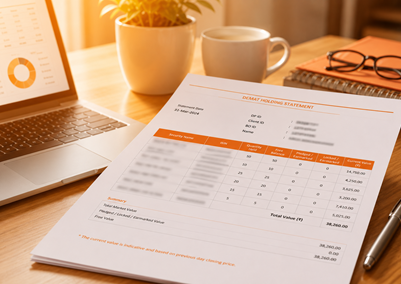
Learn how to read a demat holding statement, check securities, DP ID, client ID, BO ID, valuation and download statements from NSDL, CDSL or CAS.
391 views
9 minutes
17 Jun 2026
Discover the features of a demat account along with its benefits, uses, charges and possible disadvantages before opening an account to hold shares, ETFs, bonds and more.
391 views
8 minutes
16 Jun 2026
Elevate Your Financial Knowledge with the
ICICI Direct iLearn App
Elevate Your Financial Knowledge with the
ICICI Direct iLearn App
