







Download
iLearn application
Elevate Your Financial Knowledge with the
ICICI Direct iLearn App





Passive Investment is a strategy that focusses on replicating the index performance as opposed to daily buying and selling. ‘Index investing’ is a common passive investing strategy in which investors buy a representative benchmark and hold it for an extended period. ETF as a tool, aligns perfectly with the ideology of passive investment.
Passive investing seeks to avoid the management fees and high transaction costs that frequent trading can cause. The goal of passive investing is to help the investor growth wealth sustainably, over time. Passive investing, also known as a buy-and-hold strategy, entails purchasing a security with the intent of holding it for the long term. Unlike active traders, passive investors do not seek to profit from short-term price fluctuations or market timing. The underlying assumption of passive investment strategy is that the market will produce positive long-term returns.
Now that we know what passive investment is, let us have a look at if it can be considered a ‘Rising Trend’ in India
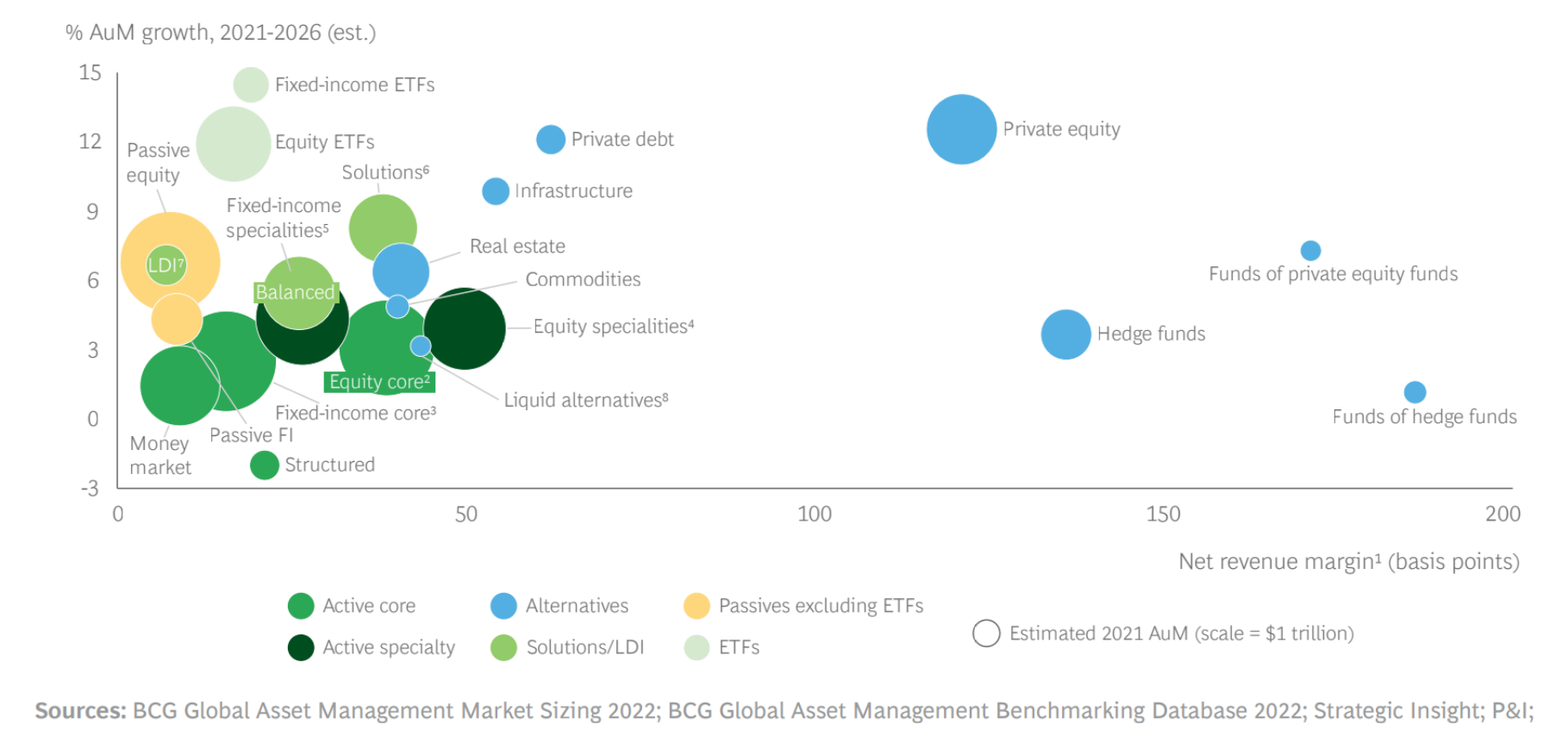
To understand, how passive investment has grown in India, we need to first look at the global picture first. So over the past 1,3 and 5 years, more than 80% of the active funds have underperformed their benchmarks globally. That, along with higher costs, has pushed the investors towards low cost passive opportunities like Exchange Traded Funds (ETFs). It is interesting to note that ETFs had grown more than four times the rate of their actively managed counterparts since 2003. (Source: BCG Report)
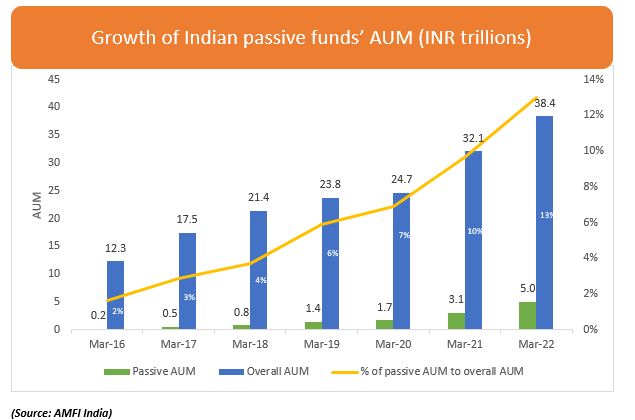
When it comes to India, if we just look at the growth of passive investment from a pure numerical perspective, it indicates towards a rapid growth picture. Over the last 5 years, the passive assets under management (AUM) has witnessed a CAGR growth of over 55%. In March 2017, the passive assets under management (AUM) in India stood at Rs 52,368 Cr, the same stood at Rs 4,99,319 Cr in March 2022 – a staggering growth of 57% CAGR.
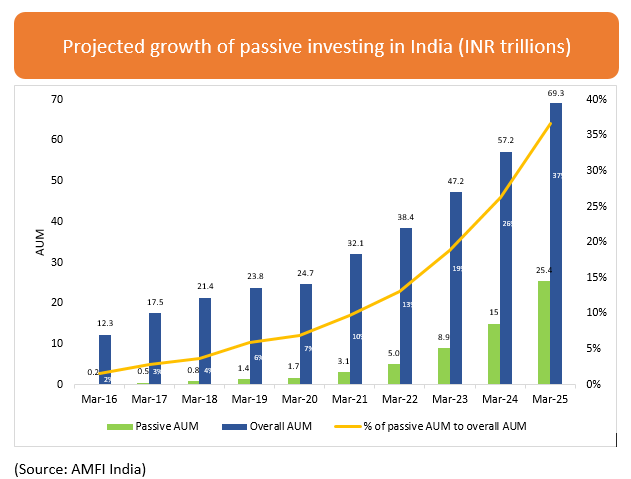
Moreover, over the last 12 months, passive assets have almost doubled. Currently passive assets are about 13% of the overall assets in India, that number expected to be nearly 40% in the next 5 years.
(Source: AMFI India)
From a pure numbers perspective, the estimated growth in the passive assets under management (AUM) looks even more impressive. The current number of nearly Rs 5 lakh crore of AUM, as on March 2022, is expected to be over Rs 25 lakh crore by March 2025. That is a staggering 5x increase in 5 years.
(Source: AMFI India)
Due to lack of frequent trading, transaction costs (commissions, etc.) are low with a passive strategy. While management fees charged by funds are unavoidable, most ETFs keep charges well below 1%. Coupled with the diversified holdings that passive strategy tools offer & lesser risk than active trading, passive investment is something that is slowly becoming an eye-catching, long-term investment product for everyone. Even from a cost point of view most ETFs are accessible to everyone as the starting point of investment can be as low as Rs 20/-.
Going by the data and estimates we are witnessing for passive investments’ influence on Indian markets, we can safely conclude that it is a trend which is on the rise and is here to stay.


Explore the meaning of a mainboard IPO, SEBI's eligibility routes, NSE and BSE listing rules, key benefits, and the checks investors should make before applying.
 1 k views
 4 minutes
 13 Aug 2026
Commodity prices don't move in isolation. Along with demand-supply dynamics and geopolitical events, one global indicator that often influences commodity prices is the US Dollar Index (DXY).
1 k views
3 minutes
11 Aug 2026
Gold can react to inflation data, while crude oil may jump after an inventory report or geopolitical disruption.
961 views
4 minutes
21 Jul 2026


Elevate Your Financial Knowledge with the
ICICI Direct iLearn App
Elevate Your Financial Knowledge with the
ICICI Direct iLearn App
