






Download
iLearn application
Elevate Your Financial Knowledge with the
ICICI Direct iLearn App





For many years there was a close association between equity markets and commodity markets. But unlike gold, equity and debt that retail investors are comfortable with, investing in commodities is not very common in India. To encourage investment in commodities, the Securities and Exchange Board of India (SEBI) has notified guidelines on mutual funds investment in commodity derivatives. Investors now have the option to include commodities in their portfolios that come with the advantage of being managed by professionals.
According to SEBI guidelines, mutual funds can invest in commodities through ETCDs (exchange-traded commodity derivatives) but they cannot take exposure to a physical commodity, except gold ETFs.
These guidelines favour investors who seek diversification of their portfolios. Retail investors can allocate a small part of the investment amount to commodity derivatives and it will help diversify the risk in their portfolios. There is a limit to the amount of diversification investors can achieve when investing in stocks. Hence, adding commodity derivatives to the portfolio will provide better diversification.
A 30% allocation of funds to commodities is ideal. For hybrid schemes, the exposure of 10% can provide a taste of commodities but will not help with diversification. Further, there is a 10% cap on a single commodity which limits the risks.
Further, the inclusion of commodity derivatives in mutual fund investments will also allow the funds to participate in raw macro triggers. Most commodity prices are a clear reflection of the demand and supply macros which lead to a better hedge against risk.
The equity and debt markets in the country have matured, while the commodity market remains in the nascent stage. There is not enough research with regard to commodities to help make the right decisions. This means there is greater inefficiency of price in commodities and a higher opportunity to generate profits.
Since mutual funds have a wide institutional network and quality research, they should be in a stronger position to work on the advantages and make profits.
Retail investors can consider dedicated mutual fund schemes to invest for exposure to commodities.
Of course, mutual fund investments in commodity trading are not without risks. Spot markets and futures markets in commodities remain discrete. The SEBI will regulate the commodity futures market but individual states have the right to regulate the commodity spot markets. The government is also quite sensitive towards the volatility in the prices of some commodities which can affect the funds.
Allowing mutual funds to invest in commodity trading is a good move in the right direction. It will lead to wider choices for retail investors and will give them exposure to commodities without directly engaging in them.
Disclaimer
ICICI Securities Ltd.( I-Sec). Registered office of I-Sec is at ICICI Securities Ltd. - ICICI Centre, H. T. Parekh Marg, Churchgate, Mumbai - 400020, India, Tel No : 022 - 2288 2460, 022 - 2288 2470. AMFI Regn. No.: ARN-0845. We are distributors for Mutual funds. Mutual Fund Investments are subject to market risks, read all scheme related documents carefully. Please note, Mutual Fund related services are not Exchange traded products and I-Sec is just acting as distributor to solicit these products. All disputes with respect to the distribution activity, would not have access to Exchange investor redressal forum or Arbitration mechanism. The contents herein above shall not be considered as an invitation or persuasion to trade or invest. I-Sec and affiliates accept no liabilities for any loss or damage of any kind arising out of any actions taken in reliance thereon. The contents herein mentioned are solely for informational and educational purpose.


Discover the right demat account for your investing needs by checking costs, platform quality, product access, safety features and support services.
 1 k views
 6 minutes
 17 Jun 2026
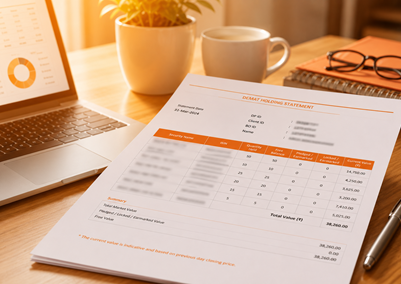
Learn how to read a demat holding statement, check securities, DP ID, client ID, BO ID, valuation and download statements from NSDL, CDSL or CAS.
543 views
9 minutes
17 Jun 2026
Discover the features of a demat account along with its benefits, uses, charges and possible disadvantages before opening an account to hold shares, ETFs, bonds and more.
507 views
8 minutes
16 Jun 2026

Elevate Your Financial Knowledge with the
ICICI Direct iLearn App
Elevate Your Financial Knowledge with the
ICICI Direct iLearn App
